
The 9 Best 16 Chainsaw of 2026
If you need a reliable tool for trimming limbs and cutting firewood, the best 16 chainsaw options can help. This roundup covers 9 top models in November 2026 from OUTESAWSUPER, NovorikX.
 By Rachel Thompson
Updated October 27, 2026
If you are shopping for the best 16 chainsaw, the details matter more than the marketing copy. A 16-inch bar can be a sweet spot for homeowners and property managers because it offers enough reach for limbing, storm cleanup, and routine cutting without moving into the bulk of larger professional saws. For a broader look at related tools, you can also explore our chainsaws and saws category.

This guide to Best 16 Chainsaw focuses on the features that actually change the cutting experience, from balance and chain speed to safety controls and maintenance. Whether you want a saw for occasional yard work or more regular property upkeep, comparing the right details will help you choose a model that feels manageable and performs consistently throughout November 2026.
| Award | Product | ACMS Score About LAT ScoreACMS Score is calculated based on product ratings, reviews, and sales performance to help you make informed purchasing decisions. | Price | |
|---|---|---|---|---|
| Best Budget |
OUTESAWSUPER 0T7C119U 16-Inch Corded Chainsaw
|
7.8/10 | $109.99 | Check price |
| Also Great |
 Husqvarna 120 Mark III 16-Inch Gas Chainsaw |
8.3/10 | $219.99 | Check price |
| Best Premium |
 EGO CS1613 16-Inch Chain Saw |
8.9/10 | $299.00 | Check price |
| Top Rated |
 WORX WG385 40V 16-Inch Chainsaw |
8.4/10 | $255.99 | Check price |
| Also Great |
 SENIX CSX6-M 16-inch Chainsaw |
7.8/10 | $159.00 | Check price |
| Best Value |
 EGO CS1611 16-Inch Cordless Chainsaw |
8.8/10 | $249.00 | Check price |
| Most Popular |
 Greenworks 20312 16-Inch Chainsaw |
8.4/10 | $249.99 | Check price |
| Also Great |
 NovorikX XLCS7B50 60V Chainsaw |
8.3/10 | $249.99 | Check price |
| Best Overall |
 EGO CS1610 16-Inch Cordless Chainsaw |
8.9/10 | $219.00 | Check price |
OUTESAWSUPER 0T7C119U 16-Inch Corded Chainsaw
This corded chainsaw uses a 16-inch bar, automatic oiling, and a quick-stop brake for yard trimming and wood prep where an outlet is nearby. The low-vibration design and Oregon chain help support smoother cuts and easier handling during longer sessions.
Pros
- 16-inch bar and 12.5 m/s chain speed for pruning and wood prep
- Automatic oiling system reduces wear and helps extend chain life
- Quick-stop brake stops rotation within 0.15 seconds when the guard is pushed
- Low-vibration design improves comfort during extended use
- Includes Oregon chain, guide bar cover, and wrench
Cons
- Corded electric power limits use to areas near an outlet
- Automatic oiling requires maintaining the oil tank
Husqvarna 120 Mark III 16-Inch Gas Chainsaw
A lightweight 16-inch gas chainsaw built for home and garden tasks like cutting firewood and limbing. It's designed for easier starting and handling, with features like an air purge system and LowVib technology to reduce operator fatigue.
Pros
- Air purge system and combined choke/stop control aim to simplify starting and reduce engine flooding.
- LowVib technology is intended to lower vibration for reduced operator fatigue during use.
- Air Injection centrifugal cleaning system helps protect the engine by removing larger debris before it reaches the air filter.
- Inertia-activated chain brake is a standard safety feature to help reduce kickback injury risk.
Cons
- As a gas-powered tool, it requires fuel mixing and regular engine maintenance.
- At 10.7 pounds, it may be heavier than some electric or battery-powered models for similar tasks.
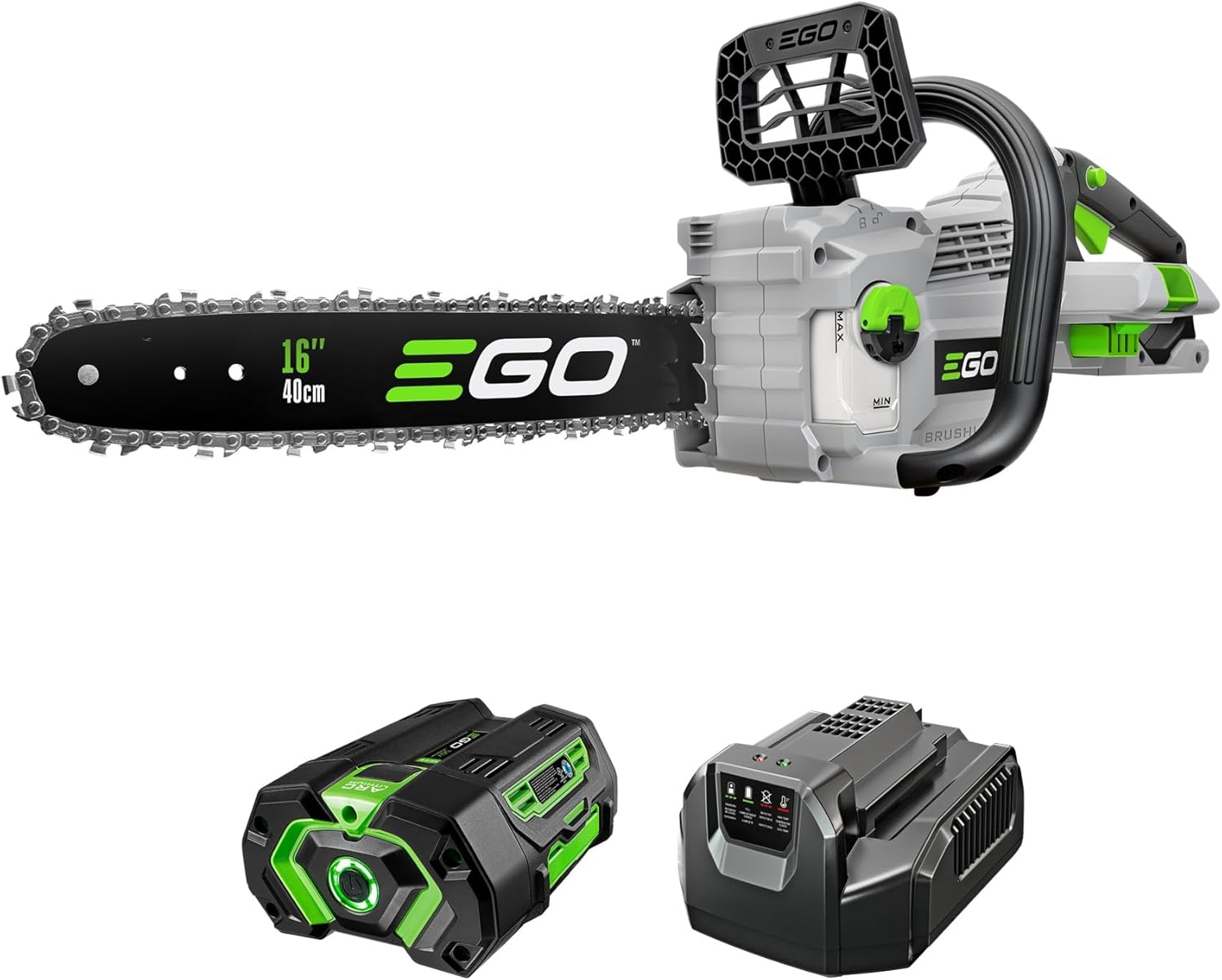
EGO CS1613 16-Inch Chain Saw
This EGO cordless chainsaw pairs a brushless motor with a 16-inch bar, making it a practical fit for homeowners who want gas-like cutting power without the fumes or noise. It includes a 4.0Ah battery and charger, plus tool-free chain tensioning and automatic oiling for easier upkeep.
Pros
- Brushless motor is rated at gas-like power equivalent to a 40cc chainsaw
- Includes a 4.0Ah battery and charger
- Tool-free chain tensioning makes adjustments quick and simple
- Automatic oiling helps keep the chain lubricated during use
- Metal bucking spikes and kickback brake add control and safety
Cons
- Heavier than some compact cordless saws at 20.9 pounds
WORX WG385 40V 16-Inch Chainsaw
The WORX WG385 pairs a 16-inch bar with a brushless 40V battery system for cordless cutting in a relatively compact format. It adds automatic chain lubrication, tool-less tensioning, and a chain brake, making it a practical pick for homeowners who want gas-free cutting with less upkeep.
Pros
- Brushless motor for stronger, longer-running performance and longer motor life.
- Cordless 40V battery setup with two included 4.0Ah batteries and a dual charger.
- Automatic chain lubrication helps keep cuts smooth and extends chain life.
- Tool-less chain tensioning and chain replacement save time.
- Quick-stop chain brake and trigger lock add useful safety features.
Cons
- 16-inch bar may be limiting for larger cutting jobs compared with bigger saws.
- Cordless runtime will still depend on battery charge and workload.
SENIX CSX6-M 16-inch Chainsaw
A 60V cordless chainsaw built around a 16-inch Oregon bar and a brushless motor. It is aimed at pruning, branch trimming, and light firewood cutting, with automatic oiling, tool-free tensioning, and ECO mode for more controlled use.
Pros
- 60V battery power with a brushless motor for strong cordless cutting performance.
- 16-inch Oregon bar and chain suited to pruning, branch trimming, and firewood.
- Automatic oiling and tool-free tensioning make upkeep easier.
- Includes a 4.0Ah battery and charger.
Cons
- At 14 pounds, it is not especially light for a cordless saw.
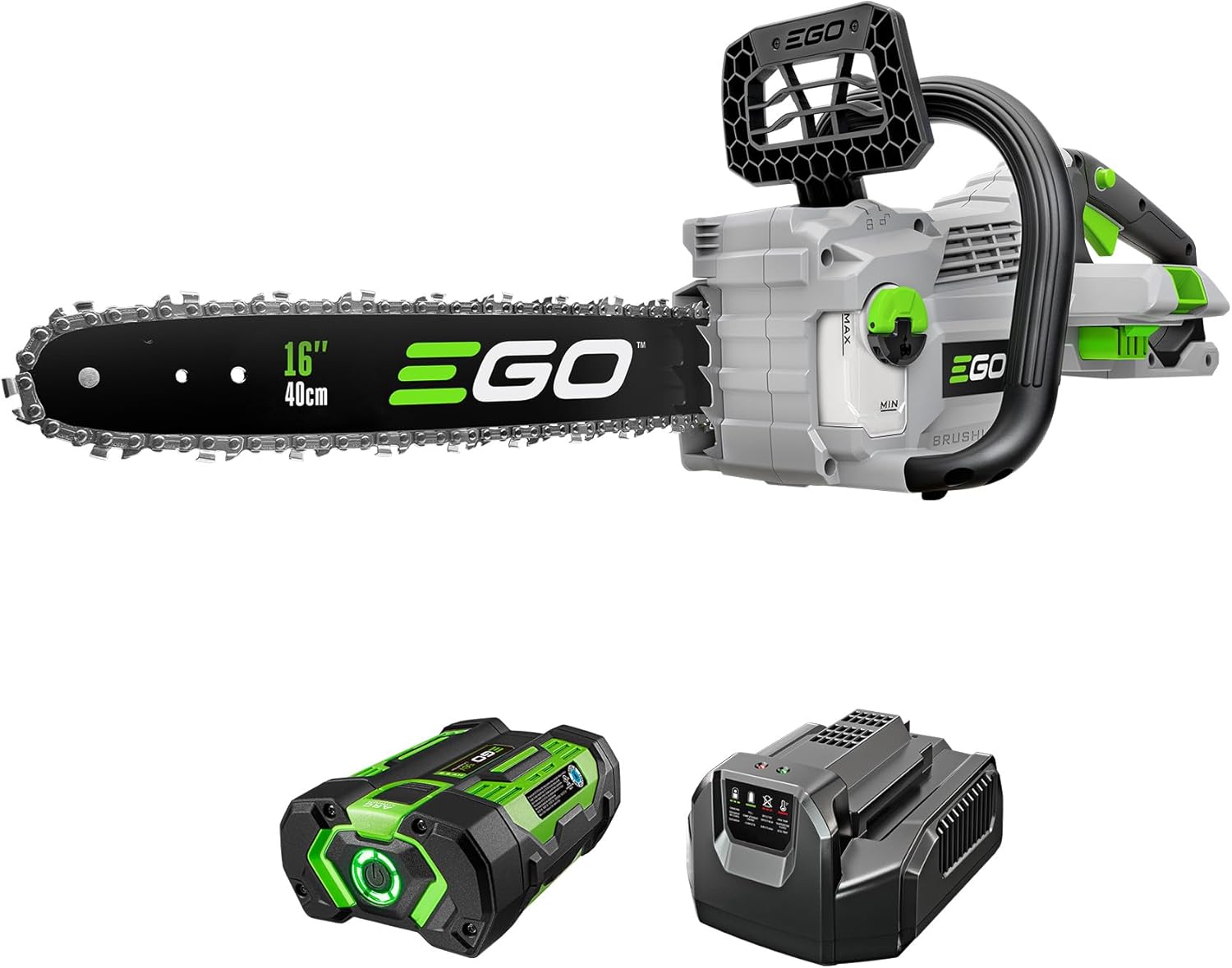
EGO CS1611 16-Inch Cordless Chainsaw
This 56V battery-powered chainsaw offers a gas-like experience without the noise or fumes. Its brushless motor matches the power of a 40CC gas model, and the tool-free tensioning system simplifies adjustments. It's a strong choice for homeowners seeking a clean, convenient alternative to gas-powered tools.
Pros
- Power equivalent to a 40CC gas chainsaw for robust cutting
- Cordless and quiet operation eliminates fumes and gas mixing
- Tool-free chain tensioning system for easy maintenance
- Automatic oiling with a spill-free reservoir
- High user rating of 4.6 stars based on 667 reviews
Cons
- Battery runtime is finite, requiring recharging or spare batteries for extended jobs
- At 9 pounds, it may be heavier than some electric competitors
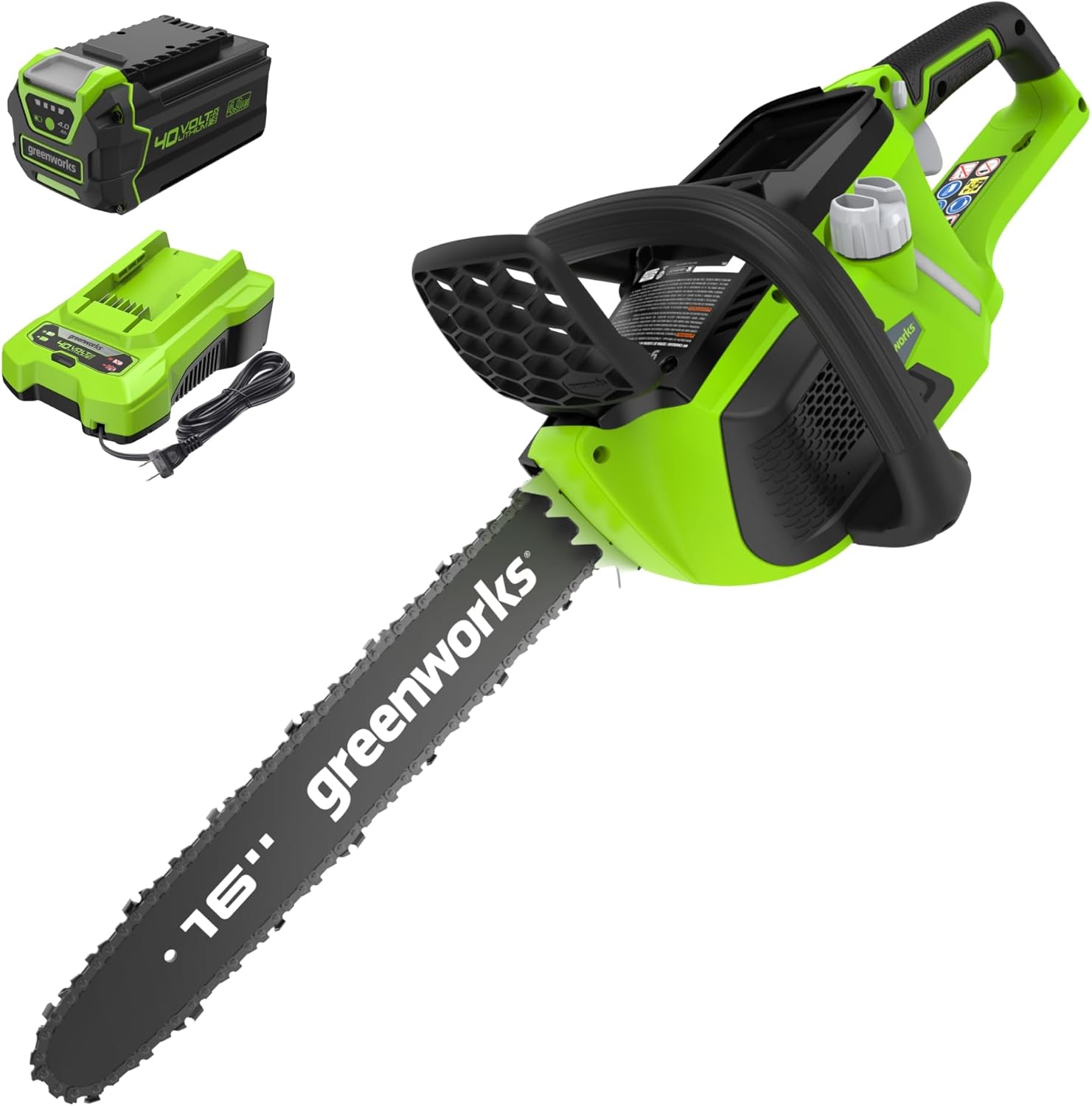
Greenworks 20312 16-Inch Chainsaw
A cordless 16-inch chainsaw built for yard work, firewood cutting, and storm cleanup. Its brushless motor, included 4.0Ah battery, and tool-free chain tensioning make it a practical pick for homeowners who want gas-free cutting with less maintenance.
Pros
- Brushless motor for better efficiency and durability.
- Includes a 4.0Ah battery and charger.
- 16-inch bar and chain suited to heavier yard tasks.
- Automatic oiler and tool-free chain tensioning simplify upkeep.
- Chain brake, low-kickback design, and ergonomic grip support safer, more comfortable use.
Cons
- At 10.4 pounds, it is not especially light for one-handed or extended overhead work.
NovorikX XLCS7B50 60V Chainsaw
This NovorikX cordless chainsaw ships with both 16-inch and 18-inch bars, so it can handle pruning one minute and small-tree felling or firewood the next. The brushless motor, automatic oiling system, and included 5.0Ah battery make it a practical pick for yard cleanup and regular cutting jobs.
Pros
- Includes both 16-inch and 18-inch guide bars for different cutting tasks.
- Brushless motor delivers strong cutting performance and a 72 ft/s chain speed.
- 5.0Ah battery is rated for up to 210 cuts on a 4x4.
- Automatic oiling system and steel bolt tensioning add convenience and stability.
- Battery, charger, goggles, gloves, earplugs, and sharpening tool are included.
Cons
- At 19.29 inches long, it may feel bulky for tight, overhead pruning work compared with smaller saws.
EGO CS1610 16-Inch Cordless Chainsaw
A premium battery-powered chainsaw that matches the power of a 40cc gas model, offering a quiet, fume-free experience. Its tool-free tensioning and automatic oiling make maintenance straightforward for regular yard work. The design cuts flush to the ground, and it's compatible with the full EGO 56V battery ecosystem.
Pros
- Power equivalent to a 40cc gas chainsaw without noise or fumes
- Tool-free chain tensioning for easy adjustments
- Automatic oiling system maintains lubrication
- IPX4-rated weather-resistant construction
- Low-profile dials enable flush cutting to the ground
Cons
- Battery and charger are sold separately
- Heavier than some electric models at 9 pounds
Best 16 Chainsaw Buying Guide for 2026
Choosing the right saw is easier when you separate the core performance factors from the cosmetic ones. In the sections below, we break down the main criteria that shape comfort, cutting efficiency, and long-term ownership value. We also link to related resources like our hand saws and pruning saws page when a manual tool may be the better fit for lighter jobs.
Bar Length and Cutting Reach
For a 16-inch chainsaw, bar length is the defining specification, but not every saw with the same advertised size behaves the same way in use. The effective cutting reach depends on the bar, the chain design, and how much usable power the motor can maintain under load. If you cut branches, logs, and storm debris of varying diameters, a true 16-inch setup gives you enough flexibility without forcing you into a heavier, more tiring machine.
As a rule of thumb, you want the bar to be longer than the wood you cut most often, but not so long that the saw becomes difficult to control. A 16-inch bar is often a practical choice because it can handle many common yard tasks while staying compact enough for overhead trimming and quick repositioning. If your work leans toward smaller pruning cuts, our small hand saw guide can help you compare alternatives before you commit to a powered option.
| Use case | Why 16 inches works | What to watch for |
|---|---|---|
| Limbing and cleanup | Enough reach for medium branches | Balance and tip control |
| Firewood prep | Good for common log sizes | Chain speed under load |
| Occasional storm work | Versatile for mixed debris | Vibration and weight |
| Property maintenance | Useful without feeling oversized | Starting and maintenance ease |
Power Source and Cutting Consistency
Power delivery is one of the biggest differences between saws that look similar on paper. Gas models tend to offer strong continuous output, while electric and battery-powered models often win on convenience, lower maintenance, and easier startup. If you cut in a residential area, a quieter, cleaner-running option may be a better fit even if raw power is slightly lower.
What matters most is how steadily the saw maintains speed when the chain enters denser wood. A saw that bogs down easily will slow your work and force more pressure from the user, which can increase fatigue. When comparing Best 16 Chainsaw, think about the type of material you cut most often and choose the power source that can keep performance predictable for that workload.
The is a useful example to consider when evaluating consistency, because the best saws in this class are the ones that hold their pace without constant adjustments. That matters when you are cutting several pieces in a row and do not want the tool to feel strained after every pass.
Weight, Balance, and User Fatigue
Weight distribution can matter more than the number on a spec sheet. A well-balanced saw feels easier to guide through a cut, especially when you are working overhead or in awkward positions. If the rear handle feels too heavy or the front end feels unstable, the saw will become tiring even if the motor is capable.
Look for a design that lets you keep a stable stance and natural wrist angle. This is especially important for homeowners who may only use a chainsaw a few times per season, because a comfortable tool reduces the learning curve. The best 16-inch options are usually the ones that let you make controlled cuts without fighting the machine at every step.
The is worth paying attention to here because balance and handling are just as important as cutting power. A saw that feels manageable in the hands can make a bigger difference than a slightly stronger one that wears you down quickly.
Safety Features and Chain Control
Safety should never be an afterthought, especially when comparing the best 16 chainsaw options for home use. Chain brakes, hand guards, low-kickback chain designs, and secure throttle controls all help reduce the chance of a mistake becoming a serious problem. These features do not replace good technique, but they do improve the margin for error.
You should also look for controls that are easy to access without changing your grip too much. A tool that starts quickly and responds predictably is often safer than one that requires awkward handling before every cut. If you are new to this category, spending a little more on a safer and more intuitive design is often worth it.
| Safety feature | Why it matters | Best for |
|---|---|---|
| Chain brake | Helps stop the chain quickly | New users and higher-risk cuts |
| Hand guard | Improves protection and control | General yard work |
| Low-kickback chain | Reduces aggressive chain reaction | Homeowners |
| Lock-off control | Prevents accidental start behavior | Shared or infrequent use |
Maintenance, Chain Tensioning, and Upkeep
Even a good chainsaw can become frustrating if maintenance is difficult. Chain tensioning, bar oil access, air filter service, and general cleaning all affect how often the tool is ready to use. The easier these tasks are, the more likely you are to keep the saw working smoothly over time.
For occasional users, tool-free or simplified adjustment systems are especially valuable because they reduce setup time and help you keep the chain properly adjusted between cuts. A loose chain cuts poorly and can be unsafe, while an overtightened chain increases wear. Choosing a model that makes maintenance straightforward is one of the simplest ways to improve long-term satisfaction with Best 16 Chainsaw.
Intended Use and Value for Your Property
Before you choose, match the saw to the kind of work you actually do. If you are mainly trimming branches and cleaning up storm debris, you want convenience and manageable weight. If you regularly split firewood or tackle denser hardwoods, consistent output and a sturdier build become more important.
Value is not just about the lowest price or the most features. The best value saw is the one that handles your most common tasks with the least frustration and the fewest compromises. That is why comparing models by use case, not just by headline specs, tends to lead to better long-term results.
Why You Should Trust Us
We build our recommendations by comparing product listings, feature sets, user-facing specifications, and the practical requirements of the category. Our goal is to identify which products make the most sense for different types of buyers, not to repeat marketing claims. We focus on details that influence day-to-day usability, safety, and maintenance so that our guidance stays useful after the unboxing phase.
We also present trade-offs clearly. When a model looks strong in one area but weaker in another, we say so. That transparency helps you choose a saw based on your own cutting habits, your comfort level, and the type of property work you expect to do.
Final Thoughts
For the best overall pick, we recommend because it sits in the strongest position for a broad range of users who want a dependable 16-inch saw for routine yard work and mixed cutting tasks. It is the kind of model that makes sense when you want one tool that can handle several jobs without feeling oversized or overly specialized.
If you are looking for the best value option, is the kind of choice we would expect to appeal to buyers who want solid everyday performance without unnecessary complexity. For a more specific use case, is a smart pick for users who care most about convenience in regular property maintenance or lighter cutting sessions. You can also compare more category-focused options on our Chainsaws & Saws hub.
Overall, the best approach is to match the saw to your workload rather than chasing the biggest number on the box. If you know you will be cutting branches, cleaning up after storms, or prepping firewood in the common 16-inch range, the right model will save time, reduce fatigue, and make the work feel much easier from start to finish.
FAQs
What is the best 16 chainsaw in 2026 for homeowners?
The best option for homeowners is usually the saw that balances cutting power, easy handling, and straightforward maintenance. A 16-inch model is often ideal because it can handle common branches and logs without becoming too bulky for occasional use. If you only need light cleanup, you may also want to compare manual tools on our hand saws and pruning saws page.
How do I choose the right 16-inch chainsaw for regular yard work?
Start with the type of cutting you do most often, then compare weight, power delivery, and safety features. For regular yard work, ease of starting and comfortable handling matter almost as much as raw cutting ability. A model that is easy to maintain will usually stay in service longer and be more pleasant to use.
Is a 16-inch bar enough for cutting firewood?
Yes, a 16-inch bar is enough for many common firewood tasks, especially when you are working with moderate log sizes. The key is to choose a saw that maintains chain speed under load so the cut stays smooth. If your wood is consistently large or dense, prioritize a model with stronger sustained performance.
What safety features should I look for in Best 16 Chainsaw?
Look for a chain brake, hand guard, and a chain designed to reduce kickback risk. These features are especially helpful for less experienced users and for anyone who only uses a saw occasionally. Good safety design should feel easy to use, not like an afterthought that gets in the way of normal operation.
How often should I maintain a chainsaw during the season?
You should check chain tension, bar oil, and general cleanliness before each use and inspect the saw more thoroughly after heavy sessions. Regular upkeep prevents dull cutting, unnecessary wear, and avoidable safety issues. If your model is easy to service, this routine becomes much faster and less frustrating.
About the author
Editor, Lawn Care Equipment. Based in Columbus, Ohio. Rachel looks after a half-acre suburban lawn and a vegetable plot. She focuses on trimmers, edgers, sweepers, tillers, and the small upgrades that make a yard easier to keep tidy.