
The 4 Best Small Tillers For Gardening of 2026
Small garden beds and tight rows need a tiller that is easy to handle and simple to store. This roundup covers 4 compact options for raised beds, borders, and small plots in November 2026.
 By admin
Updated October 27, 2026
If you are shopping for the best small tillers for gardening, you probably want a tool that can loosen soil without overpowering a narrow bed, container garden, or backyard plot. The right compact tiller should be easy to maneuver, comfortable to control, and strong enough to break up packed soil so you can plant faster and with less effort. For a broader look at garden equipment that keeps outdoor spaces manageable, you can also explore our Lawn Care Tools category.

In this guide, we compare 4 options for gardeners who want the benefits of a smaller tiller without giving up useful digging performance. We focus on handling, tine setup, cultivation depth, and how each model fits real garden tasks in November 2026. If you are also comparing other outdoor cleanup tools, our Lawn Sweepers page may help you build a more complete yard-care setup.
| Award | Product | ACMS Score About LAT ScoreACMS Score is calculated based on product ratings, reviews, and sales performance to help you make informed purchasing decisions. | Price | |
|---|---|---|---|---|
| Best Overall |
Muylux CT-20LS 20V Cordless Tiller with 2
|
8.4/10 | $39.99 | Check price |
| Best Budget |
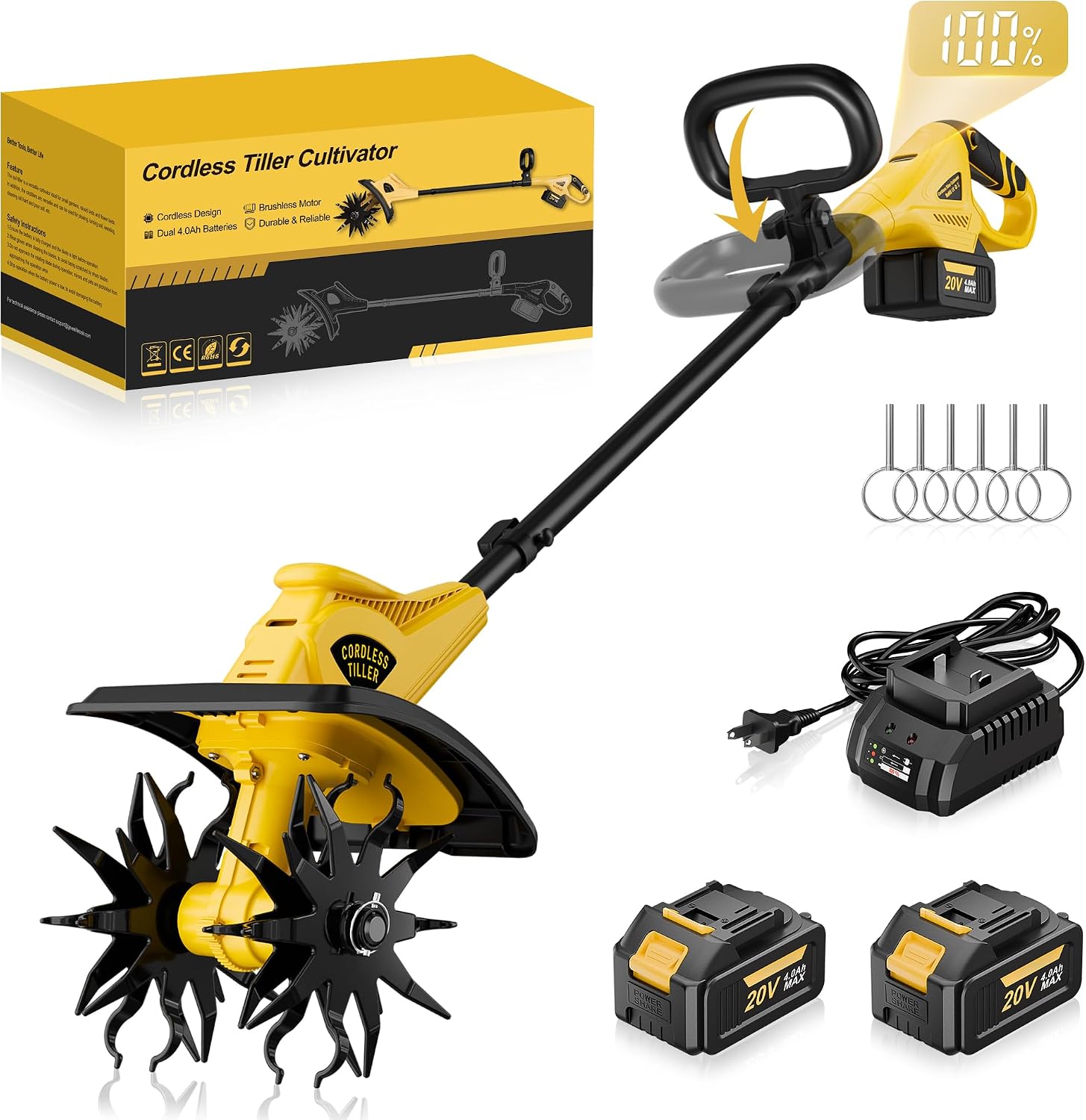 OFISPEED Cordless Tiller with Dual 4.0Ah Batteries |
8.3/10 | $89.99 | Check price |
| Best Value |
 Alloyman 20V Cordless Tiller with 4.0Ah Batteries |
8.4/10 | $99.99 | Check price |
| Best Premium |
 SENIX TL4QL-L1 46cc Tiller |
8.1/10 | $272.99 | Check price |
Muylux CT-20LS 20V Cordless Tiller with 2
This battery-powered cultivator is designed for small-scale soil work, offering cordless convenience for preparing garden beds and aerating lawns. Its lightweight, compact design makes it easy to handle in tight spaces, suitable for casual gardeners.
Pros
- Cordless operation provides excellent maneuverability and eliminates extension cord hassles.
- Comes with two batteries for extended runtime without waiting for a recharge.
- Lightweight and compact build is easy to handle and store.
- Solid 4.4-star rating from over 380 reviews indicates reliable user satisfaction.
Cons
- Soil penetration is limited to 4 inches, making it unsuitable for deep tilling or heavy-duty tasks.
- The 2.0Ah battery capacity may be less than ideal for larger garden areas.
OFISPEED Cordless Tiller with Dual 4.0Ah Batteries
This cordless tiller offers a practical, cord-free solution for medium-duty garden tasks. Its dual-battery system and brushless motor provide solid runtime and power for preparing beds and aerating soil, while its lightweight design makes it accessible for many gardeners.
Pros
- Cordless operation with two 4.0Ah batteries for extended runtime and zero downtime swapping
- Powerful brushless motor offers quiet operation, high torque, and long-term durability
- Lightweight and compact design at 10.6 lbs for easy maneuverability and storage
- Safety features include a dual-action safety switch and an adjustable, ergonomic auxiliary handle
- Comes with a comprehensive 24-month warranty and customer support
Cons
- Limited to a 12-inch tilling width, which may be narrower than some larger, gas-powered models
- Maximum 8-inch tilling depth may not be sufficient for all deep-rooted plants or initial ground-breaking tasks
Alloyman 20V Cordless Tiller with 4.0Ah Batteries
This cordless tiller offers notable freedom for small-scale gardening, with a 9-inch tilling width and two batteries included for extended runtime. It's positioned as a convenient choice for preparing raised beds and navigating tight spaces without a power cord.
Pros
- Fully cordless design enhances mobility and access to tight spaces
- Comes with two 4.0Ah batteries, allowing for longer work sessions
- Lightweight and ergonomic handle design aims to reduce user fatigue
- Features a safety switch for secure operation
- Detachable gears are noted to simplify cleaning after use
Cons
- A 9-inch tilling width may limit efficiency for larger garden plots
- Battery runtime per charge could be a constraint for extensive tilling projects
SENIX TL4QL-L1 46cc Tiller
A gas-powered cultivator for gardeners who want strong digging power without gas and oil mixing. Its 15-inch tilling width, 8-inch depth, and foldable handles make it a practical fit for routine yard work and compact storage.
Pros
- 46 cc 4-cycle full crank engine delivers strong power with low vibration.
- Patented 4QL technology eliminates gas and oil mixing and supports all-directional use.
- 6 steel forward-rotating tines provide up to 15-inch tilling width and 8-inch depth.
- Auto choke and compression release help simplify starting.
- Foldable handles make storage more compact.
Cons
- At 31.7 pounds, it is not especially light to move around.
- Gas-powered operation means more upkeep than an electric cultivator.
Best Small Tillers For Gardening Buying Guide for 2026
Choosing a compact tiller is less about chasing the most aggressive machine and more about matching the tool to the space you actually garden. Small tillers are best for raised beds, tight rows, flower borders, and refreshing soil before planting. If you need a reference point for category-level browsing, our Tillers & Cultivators page keeps the focus on this class of tools.
Working Width and Garden Size
Working width is one of the first things to think about because it determines how much soil you cover in a single pass. A narrower tiller is usually easier to control in cramped spaces, while a wider one can finish open beds faster. For small gardens, the best choice is often the model that lets you turn at row ends without repeatedly lifting and repositioning the machine.
In practical terms, a compact tiller should feel agile enough to move between established plants, but stable enough to keep the tines tracking straight. If your garden has mixed spaces, such as raised beds plus a few wider rows, look for a machine that balances precision and coverage rather than chasing the largest cut. That balance is often what separates a truly useful small tiller from one that is simply reduced in size.
As you compare options, imagine your longest planting row and the narrowest path you need to fit through. The right width should save you time without creating extra cleanup or edge trimming later.
Tine Design and Soil Breakup
Tines are the working heart of any tiller, and their shape affects how well the tool handles compacted or previously worked soil. Forward-rotating tines are often good for breaking fresh ground, while counter-rotating styles can help bite into tougher soil more aggressively. For small gardens, the best option is usually the one that loosens soil cleanly without making the bed too fluffy or uneven.
We recommend paying attention to whether the tines are designed for cultivation, weeding, or initial breaking. Some compact models are better at refining soil than forcing their way through dense clay. If your garden soil tends to crust over after rain, a tiller with more assertive tine action can save you from repeated passes and reduce hand digging.
The most useful test is simple: ask whether the tiller will make the soil easier to plant in after one controlled pass. If the answer is yes, the machine is doing the job it should.
The compact build of Product 3 makes it a good example of why tine behavior matters in a small garden. A tool like this is most useful when it can stay controllable in tight beds while still loosening soil enough for transplanting and seed starting.
Power Source and Runtime Expectations
Power source shapes both convenience and performance. Corded electric models can deliver consistent operation as long as you have an outlet nearby, while cordless options improve mobility and reduce cable management. For a small yard, cordless convenience can be a major advantage, but you should still think about how long you plan to work in a single session.
If you usually prep one bed at a time, runtime may be less important than maneuverability. On the other hand, if you like to tackle several planting areas in one weekend, a model with enough endurance to handle repeated use matters more. The main goal is to avoid a tool that stops just as you reach the most compacted section of the bed.
Below is a simple comparison framework you can use while reading the product cards above:
| Garden need | What to prioritize |
|---|---|
| Raised beds | Lightweight handling and narrow maneuvering |
| Tight borders | Precise steering and compact tine coverage |
| Previously worked soil | Smoother cultivation and easy depth control |
| Hard-packed ground | More assertive tine action and solid torque |
Weight, Balance, and Ease of Control
For small tillers, weight is not just about portability. It also affects how the tool behaves when you press the tines into the soil. A unit that is too light may bounce across hard ground, while one that is too heavy can become tiring in raised beds or narrow paths. The best balance is usually a tiller you can guide with steady pressure instead of muscling through every pass.
Balance also matters when turning at bed edges or stopping at a border. If the machine feels nose-heavy, it can be harder to keep the cut even. If it feels too rear-biased, the tines may not stay engaged consistently. Good control is especially important for gardeners who want to cultivate close to existing plants without damaging roots.
When reading reviews or product descriptions, look for clues about easy starting, comfortable grips, and stable tracking. Those details often reveal more about day-to-day usability than a headline specification alone.
Depth Adjustment and Seasonal Flexibility
Depth control gives a small tiller more versatility than many shoppers expect. Shallow cultivation is useful for mixing in compost, leveling soil, or lightly refreshing a bed before planting. Deeper settings are better when you need to break up compacted areas or work amendments into the soil profile more thoroughly.
The most practical machines are the ones that make adjustment simple. If you garden in different seasons, you may want a shallower setting for quick maintenance and a deeper setting for heavier spring prep. That flexibility lets one tool handle several jobs without forcing you to buy separate equipment for each task.
Before you choose, think about the soil you actually maintain most often. A small tiller that is excellent in loose soil but awkward in harder ground may not be enough if your beds often dry out between watering cycles.
Product 2 is a useful example to consider when depth and control matter together. A compact tiller that can stay composed while you adjust pressure is often more valuable than a stronger machine that feels hard to steer in real garden rows.
Storage, Maintenance, and Long-Term Value
Because small tillers are often used seasonally, storage convenience should not be overlooked. A compact frame, folding handle, or easy-to-clean tine area can make a big difference when you put the machine away between planting cycles. If you have limited shed space, a smaller footprint can matter just as much as performance in the soil.
Maintenance also affects value over time. Look for a design that is easy to clean after damp soil use and straightforward to inspect before the next job. Even a well-built tiller will last longer if you take a few minutes to remove soil buildup and check moving parts after use.
If you want to keep your yard-care routine efficient across the season, pairing a compact tiller with other practical tools can help. Our Lawn Care Tools category is a good place to compare other equipment that supports the same goal of easier maintenance.
Why You Should Trust Us
We build our recommendations around product data, feature comparison, and category-specific buying priorities rather than marketing language alone. For a guide like this, that means looking at how each tiller is positioned for handling, soil prep, and everyday usability in smaller garden spaces. We focus on what matters most to a home gardener: control, convenience, and practical performance.
We also try to stay transparent about what can and cannot be inferred from the available product information. If a product listing does not provide enough detail, we avoid making unsupported claims and instead weigh it by the information that is present. That approach helps you compare models more confidently and choose a tool that fits your garden instead of guessing based on a headline feature.
Final Thoughts
For the best overall pick, we would point you toward the product in our roundup because it sits at the top of the comparison and is the first model to evaluate if you want a compact tiller that can anchor a small-garden setup. It is the kind of choice that makes sense when you want one tool to handle multiple planting areas without feeling oversized.
For a best value style recommendation, the product is worth a close look because value in this category is usually about how well a tool balances control, ease of use, and soil preparation without adding unnecessary complexity. If you are comparing compact tools for specific beds or borders, that balance often matters more than headline size. For a best for specific use pick, the product stands out as a smart option to inspect if your priority is tight-space cultivation and precise handling in smaller planting areas.
If you want to keep comparing garden equipment, you can continue with our Tillers & Cultivators category or look at other outdoor maintenance tools in the Lawn Care Tools hub. The right small tiller should make your garden easier to manage, not more complicated, and that is the standard we use when narrowing down the best choices.
FAQs
What is the best small tillers for gardening in 2026?
The best small tillers for gardening in 2026 is the one that fits your soil type, bed size, and storage space. For many home gardeners, that means choosing a compact model that is easy to steer and strong enough to loosen planting soil without making the tool feel unwieldy. Start by comparing the top picks in this guide and focus on control first, then power.
Are small tillers good for raised beds?
Yes, small tillers can be excellent for raised beds because they are easier to guide in narrow spaces than full-size machines. The key is selecting a model that offers enough stability to stay in the soil without bouncing around. A lighter, more compact design is usually the better fit for delicate bed work.
How deep should a small garden tiller cut?
Most home gardeners want enough depth to loosen soil and mix in compost without disturbing roots too aggressively. Shallow passes work well for maintenance and seedbed prep, while deeper passes are better for breaking compacted soil before planting. The best depth for you depends on whether you are refreshing a bed or preparing a new one.
How do I choose between corded and cordless best small tillers for gardening?
Choose corded if you want consistent operation and usually work near an outlet, and choose cordless if you value mobility and easier movement around the yard. Cordless models are often more convenient for small gardens with multiple sections, while corded tools can be simpler if runtime is not a concern. The best choice depends on how far you need to move while cultivating.
Where can I compare more garden tools besides best small tillers for gardening?
You can browse our Lawn Care Tools hub for more outdoor equipment comparisons, or head back to the Tillers & Cultivators category for closely related options. That makes it easier to compare tools side by side and build a more complete garden maintenance setup.
About the author

admin writes reviews and buying guides for LAT Review.