
The 9 Best Quality Chainsaw of 2026
When you need a best quality chainsaw, the right model can make cutting safer, faster, and less tiring. 9 options from NovorikX stand out in November 2026 for strong performance and dependable build quality.
 By Maria Delgado
Updated October 27, 2026
If you are comparing the best quality chainsaw for yard cleanup, storm prep, or routine tree work, the details matter more than the headline claims. A good chainsaw should balance cutting power, control, safety features, and ease of maintenance so you can work efficiently without fighting the tool. In this guide, we look at 9 options to help you narrow the field and choose with confidence.

We also recommend checking our Chainsaws & Saws category page if you want to compare this guide with other cutting tools. For readers who need a broader perspective, our roundup approach helps you understand how each saw fits different tasks, from limbing branches to handling larger cuts.
| Award | Product | ACMS Score About LAT ScoreACMS Score is calculated based on product ratings, reviews, and sales performance to help you make informed purchasing decisions. | Price | |
|---|---|---|---|---|
| Most Popular |
Husqvarna 120 Mark III 16-Inch Gas Chainsaw
|
8.3/10 | $219.99 | Check price |
| Best Overall |
 Greenworks CS40L515 18-Inch Chainsaw |
9.2/10 | $349.99 | Check price |
| Also Great |
 Greenworks CS24L410 12-Inch Cordless Chainsaw |
8.1/10 | $139.00 | Check price |
| Top Rated |
 Greenworks 80V 18-Inch Brushless Cordless Chainsaw |
8.4/10 | $349.99 | Check price |
| Also Great |
 Husqvarna Power Axe 350i 18-Inch Battery Chainsaw |
8.3/10 | $479.99 | Check price |
| Best Budget |
 Greenworks CS40B210 40V Cordless Chainsaw |
8.4/10 | $139.99 | Check price |
| Best Premium |
 Husqvarna 460 Rancher 24-Inch Gas Chainsaw |
8.6/10 | $649.00 | Check price |
| Best Value |
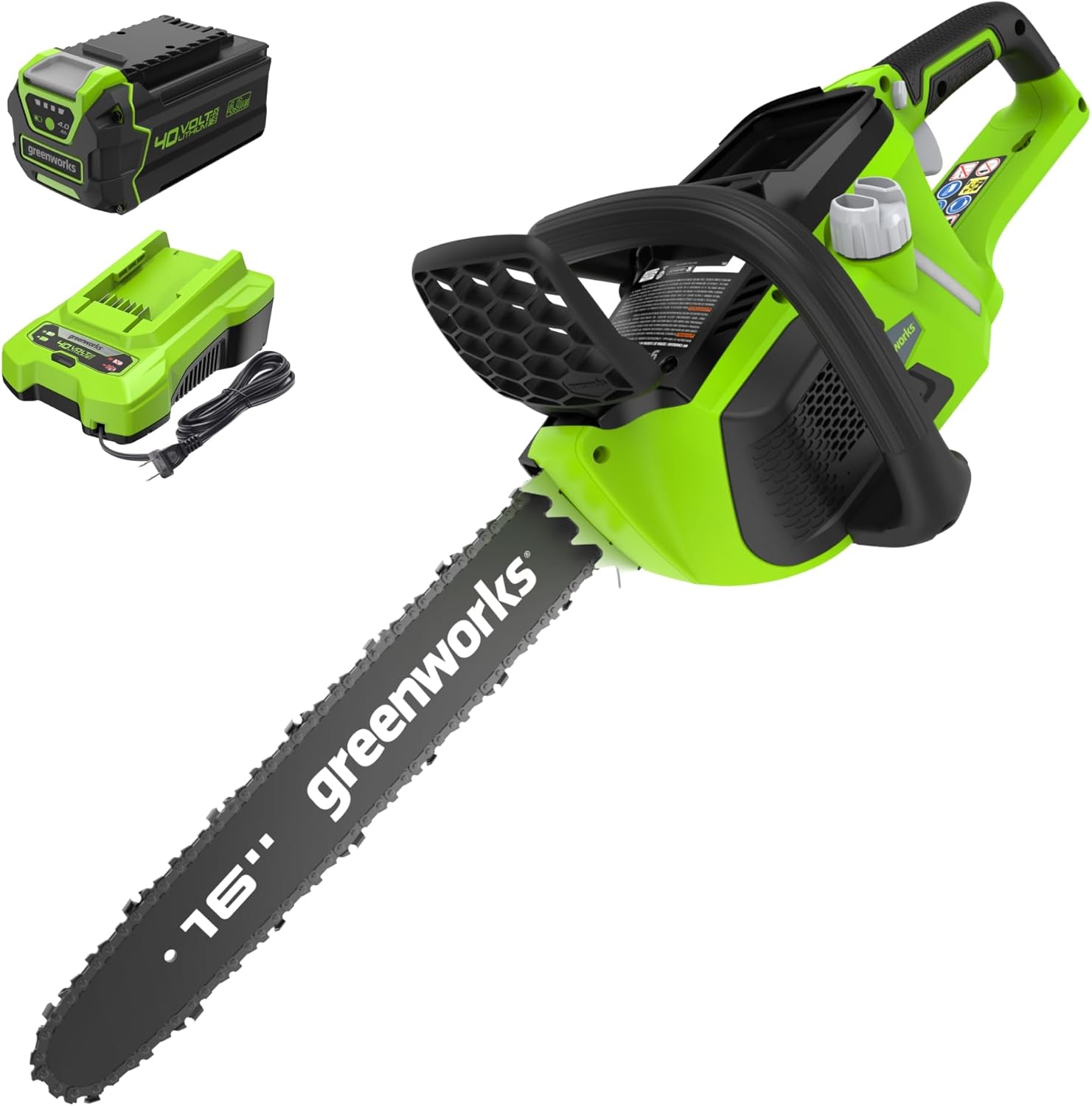 Greenworks 20312 16-Inch Chainsaw |
8.4/10 | $249.99 | Check price |
| Also Great |
 NovorikX XLCS7B50 60V Chainsaw |
8.3/10 | $249.99 | Check price |
Husqvarna 120 Mark III 16-Inch Gas Chainsaw
A lightweight 16-inch gas chainsaw built for home and garden tasks like cutting firewood and limbing. It's designed for easier starting and handling, with features like an air purge system and LowVib technology to reduce operator fatigue.
Pros
- Air purge system and combined choke/stop control aim to simplify starting and reduce engine flooding.
- LowVib technology is intended to lower vibration for reduced operator fatigue during use.
- Air Injection centrifugal cleaning system helps protect the engine by removing larger debris before it reaches the air filter.
- Inertia-activated chain brake is a standard safety feature to help reduce kickback injury risk.
Cons
- As a gas-powered tool, it requires fuel mixing and regular engine maintenance.
- At 10.7 pounds, it may be heavier than some electric or battery-powered models for similar tasks.
Greenworks CS40L515 18-Inch Chainsaw
A cordless 40V chainsaw built for pruning, limbing, firewood, and storm cleanup. The 18-inch bar, brushless motor, and included 5.0Ah battery point to strong cutting capacity with push-button starting and low-maintenance operation.
Pros
- 18-inch bar and chain can handle tree limbs and trunks up to 32 inches in diameter
- Brushless 40V motor delivers gas-like power for yard cutting tasks
- Includes a 5.0Ah battery and 5A rapid charger
- Tool-less chain tensioning and an auto oiler simplify upkeep
- Lightweight at 9.7 pounds, which can help reduce fatigue
Cons
- Battery-powered runtime will depend on the included 5.0Ah pack and the work load
- At 37.6 inches long, it is still a full-size saw rather than a compact pruner
Greenworks CS24L410 12-Inch Cordless Chainsaw
A battery-powered electric chainsaw designed for light-duty yard work like pruning and trimming. It features a brushless motor for more torque and quiet operation, plus tool-free chain tensioning for easy maintenance.
Pros
- Brushless motor provides increased torque and longer life
- Tool-less chain tensioning simplifies maintenance
- Automatic oiler ensures proper chain lubrication
- Cordless, push-button start eliminates gas and fumes
- Battery platform is compatible with over 100 other Greenworks tools
Cons
- Designed for light-duty tasks, not heavy-duty cutting
- Battery and charger are sold separately (tool only)
Greenworks 80V 18-Inch Brushless Cordless Chainsaw
This 80V cordless chainsaw leverages brushless motor technology to deliver gas-comparable power for demanding tasks like tree felling and limbing. It offers significant user-friendly advantages, including push-button start and an automatic oiler, making it a strong contender for professionals seeking a cleaner, quieter alternative.
Pros
- Powerful brushless motor provides torque comparable to a 42cc gas model.
- Long runtime capable of up to 150 cuts on 4x4 lumber per charge.
- User-friendly features like push-button start and automatic chain oiling.
- Quiet, fume-free operation with no need for gas, spark plugs, or starter ropes.
- Part of a large 80V ecosystem with over 75 compatible tools.
Cons
- The included 2.0Ah battery may limit continuous runtime for very large jobs.
- At 18 inches, the bar length is fixed and may be less versatile for smaller pruning tasks.
Husqvarna Power Axe 350i 18-Inch Battery Chainsaw
A cordless, all-in-one kit designed for homeowners tackling yard maintenance like pruning and cutting firewood. It prioritizes convenience with a lightweight, battery-powered design and a tool-less chain tensioner, while its brushless motor and boost mode aim to deliver power competitive with some gas models.
Pros
- Complete kit includes saw, battery, and charger
- Lightweight design reduces user fatigue during operation
- Tool-less chain tensioning system for easy adjustments
- Boost mode provides a temporary 25% power increase
- Equipped with a durable and efficient brushless motor
Cons
- Battery runtime is dependent on the included single battery capacity
Greenworks CS40B210 40V Cordless Chainsaw
This cordless chainsaw from Greenworks is a capable tool for light-duty yard work, offering the convenience of a shared 40V battery system. It's well-suited for homeowners tackling pruning, limbing, and storm cleanup, with a design that emphasizes safety and ease of use.
Pros
- Lightweight and portable at just over 6 lbs, reducing user fatigue.
- Tool-free chain tensioning and dual safety switches for straightforward, safer operation.
- Battery doubles as a portable power bank for charging phones and tablets.
- Comes with a 3-year warranty for the tool and battery.
- Part of a large 40V platform compatible with many other Greenworks outdoor tools.
Cons
- The included 2.0Ah battery offers a runtime of about 50 cuts, which may be limiting for larger projects.
- At 12 inches, the bar length is best for smaller-diameter branches and light cutting tasks.
Husqvarna 460 Rancher 24-Inch Gas Chainsaw
A high-power, 60.3-cc gas chainsaw designed for demanding tasks like felling trees and processing firewood. It balances robust performance with user-focused features, including easy-start technology and vibration dampening. This model is well-suited for landowners and professionals tackling heavy cutting work.
Pros
- Powerful 3.6-HP X-Torq engine for demanding cutting jobs
- Smart Start system and side-mounted tensioner for easier operation
- LowVib technology and ergonomic handle reduce user fatigue
- Air Injection centrifugal air cleaning extends engine life
- Warranty can be extended to 5 years with fuel purchase
Cons
- Heavy-duty 60.3-cc engine and 24-inch bar make it a substantial tool, weighing 13.2 pounds
- Requires mixing 2-stroke oil with gasoline, adding maintenance complexity
- Large bar size may be unwieldy for lighter tasks or less experienced users
Greenworks 20312 16-Inch Chainsaw
A cordless 16-inch chainsaw built for yard work, firewood cutting, and storm cleanup. Its brushless motor, included 4.0Ah battery, and tool-free chain tensioning make it a practical pick for homeowners who want gas-free cutting with less maintenance.
Pros
- Brushless motor for better efficiency and durability.
- Includes a 4.0Ah battery and charger.
- 16-inch bar and chain suited to heavier yard tasks.
- Automatic oiler and tool-free chain tensioning simplify upkeep.
- Chain brake, low-kickback design, and ergonomic grip support safer, more comfortable use.
Cons
- At 10.4 pounds, it is not especially light for one-handed or extended overhead work.
NovorikX XLCS7B50 60V Chainsaw
This NovorikX cordless chainsaw ships with both 16-inch and 18-inch bars, so it can handle pruning one minute and small-tree felling or firewood the next. The brushless motor, automatic oiling system, and included 5.0Ah battery make it a practical pick for yard cleanup and regular cutting jobs.
Pros
- Includes both 16-inch and 18-inch guide bars for different cutting tasks.
- Brushless motor delivers strong cutting performance and a 72 ft/s chain speed.
- 5.0Ah battery is rated for up to 210 cuts on a 4x4.
- Automatic oiling system and steel bolt tensioning add convenience and stability.
- Battery, charger, goggles, gloves, earplugs, and sharpening tool are included.
Cons
- At 19.29 inches long, it may feel bulky for tight, overhead pruning work compared with smaller saws.
Best Quality Chainsaw Buying Guide for 2026
Choosing the right saw is easier when you focus on how you actually plan to use it. Some users need a lightweight option for occasional pruning, while others need a more powerful model for repeated cuts and larger trunks. Below, we break down the main factors that separate a practical saw from one that only looks capable on paper.
Cutting Power and Task Match
Cutting power should match the wood you expect to cut most often. If your work is mostly small limbs, a lighter setup can be easier to maneuver and less tiring over time. For thicker hardwood or frequent cut sessions, you want a model that maintains speed under load and does not bog down when the blade meets resistance.
It helps to think in terms of workload instead of just raw strength. A saw that feels powerful for a few cuts may become frustrating if it overheats or slows quickly during longer jobs. When you compare models, look for signs of consistent performance, usable bar length, and a design that fits your typical cutting diameter.
If you are sorting options by task, our best pruning saw for large branches guide can also help you decide when a hand tool makes more sense than a powered saw. That comparison is useful for homeowners who do a mix of cleanup and light branch removal.
Bar Length and Reach
Bar length affects both reach and cutting capacity. A longer bar can handle larger logs, but it also adds weight and can make the saw harder to control in tight spaces. If you mostly work around fences, shrubs, or awkward angles, a moderate bar can be the better balance.
For general yard use, you want enough length to cut comfortably without forcing the tool through oversized material. The safest approach is to choose a bar that gives you a little extra room beyond your average branch size, while still feeling manageable in one or two hands. That balance is often what separates a convenient saw from one that feels clumsy after a few minutes.
The Product 2 model is a useful example of why bar balance matters. Even when a saw has capable cutting potential, the way the body distributes weight can determine whether you stay accurate through the whole cut or start fighting the tool as fatigue builds.
Safety Features and Control
Safety should be a top priority because chainsaws demand attention even during simple jobs. Features such as chain brakes, low-kickback design, hand guards, and secure grip surfaces all contribute to a safer experience. These elements do not replace careful handling, but they can reduce the chance of a mistake becoming a serious problem.
Control matters just as much as raw protection. A saw that starts smoothly, feels balanced in your hands, and responds predictably is easier to manage around branches, ladders, and uneven ground. If you are newer to saws, prioritize comfort and stability over aggressive specs that may look impressive but feel harder to control in real use.
| Safety Factor | Why It Matters | What to Look For |
|---|---|---|
| Chain brake | Helps stop the chain quickly in sudden movement | Easy-to-reach activation and reliable engagement |
| Grip design | Improves steadiness and reduces hand fatigue | Textured handle and secure hold |
| Kickback control | Reduces sudden upward movement | Low-kickback chain or protective features |
| Guarding | Protects the user during handling | Hand guard and chain cover support |
Weight, Balance, and Fatigue
A saw can have strong cutting ability and still be difficult to use if it feels front-heavy or awkward. Weight distribution affects how long you can work before your arms, shoulders, and grip begin to tire. That is especially important if you plan to cut overhead limbs or work for longer sessions.
Good balance makes the tool feel more natural and helps you guide the chain more accurately. If two models look similar, the one that seems easier to steady during startup, repositioning, and finishing cuts is often the better everyday choice. For many buyers, comfort is not a luxury, it is what makes the saw useful enough to keep reaching for.
When your workload includes trimming and cleanup rather than heavy felling, lighter handling can be more valuable than chasing maximum output. For readers building a broader toolkit, our best small hand saw guide is a good companion read for detail work around the garden.
The Product 4 model is worth studying if you care about balance in tighter work areas. A saw that feels controllable near obstacles can save time and reduce stress, especially when you are making repeated cuts instead of one large pass.
Maintenance, Chain Tension, and Long-Term Value
The best quality chainsaw should also be practical to maintain. Chain tensioning, lubrication access, cleaning, and replacement parts all affect long-term usability. A tool that is easy to keep in working order tends to deliver better value because it stays ready when you need it.
Routine maintenance is not just about longevity. It also affects how safely and smoothly the saw performs from one job to the next. A properly tensioned chain cuts more predictably, while a neglected chain can increase vibration, reduce efficiency, and create unnecessary wear. If a saw makes upkeep confusing, that hidden hassle can cost you more time than the purchase saved.
To compare maintenance-friendly tools, look for accessible adjustment points, clear user guidance, and construction that does not make basic servicing difficult. A well-designed saw should help you stay consistent with upkeep rather than turning maintenance into a chore you put off.
Use Case, Storage, and Ownership Fit
Finally, think about where and how often you will store and use the saw. If you only need it a few times a season, compact storage and easy startup may matter more than maximum cutting capacity. If you use it frequently, ergonomics and long-run reliability become more important than portability alone.
Ownership fit also includes how comfortable you feel with the tool’s learning curve. Some saws are better for casual homeowners, while others suit experienced users who want more aggressive performance. The right choice is the one that matches your skill level, your yard, and the type of cuts you actually make.
Why You Should Trust Us
We use a data-driven review process focused on product positioning, feature sets, category relevance, and consistency across the available listings. Rather than relying on marketing language alone, we compare what each model is designed to do and how well it fits the needs of typical buyers looking for a best quality chainsaw.
Our goal is to present useful, transparent guidance without overstating claims. When product data is limited, we avoid making assumptions and instead focus on the details that matter most for real-world buying decisions: control, safety, upkeep, and how the saw fits your work style. That approach helps you make a smarter choice with less guesswork.
Final Thoughts
After comparing the field, our best overall pick is Product 1 because it leads the lineup and is positioned as the strongest all-around choice for buyers who want a balanced starting point. If you want a practical option for everyday yard work, that is the one we would look at first. For readers who want to explore more tool roundups, our Hand Saws & Pruning Saws page is a helpful companion category.
For the best value pick, Product 2 stands out as a sensible alternative when you want a solid balance of performance and usability without chasing the most specialized setup. If your needs are more specific, Product 3 is the best fit for buyers who care most about a focused use case and want a model that matches a narrower set of cutting priorities.
Whichever model you choose, the smartest move is to match the saw to your actual workload instead of overspending on features you will not use. For a broader overview of this category, you can also revisit the main Chainsaws & Saws page and compare related guides before you buy.
FAQs
What is the best quality chainsaw in 2026?
The best quality chainsaw in 2026 depends on your intended use, but the strongest all-around option is usually the model that balances control, cutting ability, and maintenance ease. If you need a saw for routine yard work, look for a design that feels stable and does not overwhelm you during longer jobs.
For lighter trimming, a more manageable saw can be a better choice than the most aggressive one. That is why it helps to compare the top options side by side instead of focusing on one feature alone.
How do I choose the right chainsaw size for my yard?
Start by measuring the average diameter of the branches or logs you cut most often. Then choose a bar length and power level that gives you enough capacity without making the tool difficult to steer. If you mostly trim limbs, you usually do not need the largest option available.
Matching the saw to your yard keeps the tool easier to handle and often improves safety. A properly sized saw is usually more useful than a bigger one that feels heavy or awkward.
What safety features matter most in a chainsaw?
The most important safety features are a dependable chain brake, good grip design, and kickback reduction. These features help control the saw during unexpected movement and make the tool easier to hold securely while you work.
You should also pay attention to hand guards and overall balance. A saw that feels predictable is often safer in real use than one that simply lists more protective features on paper.
How often should I maintain my chainsaw?
Basic maintenance should happen regularly, especially after heavy use. That includes checking chain tension, cleaning debris, and making sure the tool remains properly lubricated and ready for the next job. Neglecting maintenance can reduce cutting performance and shorten the tool’s useful life.
If you are comparing maintenance-friendly options, review the models that make adjustments and cleaning straightforward. Ease of upkeep is one of the best indicators of long-term ownership satisfaction.
Is a lighter chainsaw always better?
Not always. A lighter saw is often easier to control and less tiring, but it may not be the best choice if you need to cut thicker wood or work for long periods. The right balance is the lightest tool that still handles your normal workload effectively.
If you want to compare alternatives, our best garden hand saws guide is a useful reference for jobs where portability and precision matter more than powered cutting.
About the author
Editor, Garden Hand Tools. Based in Phoenix, Arizona. Maria grows vegetables and native desert plants in a small backyard and cares most about tools that stay sharp and comfortable in the heat. She writes about pruners, loppers, shovels, and everyday hand tools.