
The 7 Best Pruning Chainsaw of 2026
A lightweight and powerful pruning chainsaw makes quick work of tree limbs and garden cleanup. Our 2026 roundup highlights the top models that balance cutting performance with ease of use.
 By Carolyn Brooks
Updated October 27, 2026
Pruning trees and large branches is a demanding task that requires the right tool for efficiency and safety. A dedicated pruning chainsaw, designed for overhead and precise cutting, can transform this challenging chore into a manageable one. In this comprehensive guide, we’ve analyzed the market to bring you our top picks for 2026, helping you navigate the key features and find the perfect tool for your garden or orchard needs. For other essential pruning tools, explore our guide on the best garden loppers.

Choosing the best pruning chainsaw involves balancing power, weight, bar length, and safety features. Whether you’re dealing with fruit trees, clearing storm damage, or maintaining a wooded property, the right model makes all the difference. Our 7 selections for November 2026 represent the current leaders in this specialized category, evaluated on their specifications and user-focused design.
| Award | Product | ACMS Score About LAT ScoreACMS Score is calculated based on product ratings, reviews, and sales performance to help you make informed purchasing decisions. | Price | |
|---|---|---|---|---|
| Top Rated |
Husqvarna 120 Mark III 16-Inch Gas Chainsaw
|
8.3/10 | $219.99 | Check price |
| Most Popular |
 SENIX CSX6-M1 60V 18-Inch Chainsaw |
7.8/10 | $169.00 | Check price |
| Best Value |
 SENIX CSX6-M 16-inch Chainsaw |
7.8/10 | $159.00 | Check price |
| Best Premium |
 DeWalt DCCS623L1 Cordless Pruning Chainsaw |
8.8/10 | $248.99 | Check price |
| Best Overall |
 WORX WG327 20V 6 in Pruning Saw |
8.8/10 | $139.99 | Check price |
| Also Great |
 Greenworks CS24L211-00 6-Inch Pruning Chainsaw |
8.3/10 | $144.49 | Check price |
| Best Budget |
 DEWALT DCCS623B 8-Inch Cordless Pruning Chainsaw |
8.6/10 | $145.60 | Check price |
Husqvarna 120 Mark III 16-Inch Gas Chainsaw
A lightweight 16-inch gas chainsaw built for home and garden tasks like cutting firewood and limbing. It's designed for easier starting and handling, with features like an air purge system and LowVib technology to reduce operator fatigue.
Pros
- Air purge system and combined choke/stop control aim to simplify starting and reduce engine flooding.
- LowVib technology is intended to lower vibration for reduced operator fatigue during use.
- Air Injection centrifugal cleaning system helps protect the engine by removing larger debris before it reaches the air filter.
- Inertia-activated chain brake is a standard safety feature to help reduce kickback injury risk.
Cons
- As a gas-powered tool, it requires fuel mixing and regular engine maintenance.
- At 10.7 pounds, it may be heavier than some electric or battery-powered models for similar tasks.
SENIX CSX6-M1 60V 18-Inch Chainsaw
This SENIX cordless chainsaw pairs a 60V battery system with an 18-inch Oregon bar for pruning, branch trimming, and general yard cutting. It stands out for its brushless motor, automatic oiling, tool-free tensioning, and included battery and charger, making it a practical pick for users who want cordless convenience with stronger cutting performance.
Pros
- 18-inch Oregon bar supports pruning, branch trimming, and cutting firewood.
- Brushless motor is rated to extend runtime compared with conventional battery chainsaws.
- Includes a 4.0Ah battery and charger, so it is ready to use out of the box.
- Tool-free tensioning and automatic oiling simplify upkeep.
- ECO Mode can help conserve energy on lighter pruning jobs.
Cons
- At 16 pounds, it is relatively heavy for a cordless saw.
SENIX CSX6-M 16-inch Chainsaw
A 60V cordless chainsaw built around a 16-inch Oregon bar and a brushless motor. It is aimed at pruning, branch trimming, and light firewood cutting, with automatic oiling, tool-free tensioning, and ECO mode for more controlled use.
Pros
- 60V battery power with a brushless motor for strong cordless cutting performance.
- 16-inch Oregon bar and chain suited to pruning, branch trimming, and firewood.
- Automatic oiling and tool-free tensioning make upkeep easier.
- Includes a 4.0Ah battery and charger.
Cons
- At 14 pounds, it is not especially light for a cordless saw.
DeWalt DCCS623L1 Cordless Pruning Chainsaw
A compact and lightweight 20V cordless chainsaw built for pruning and trimming. Its brushless motor and auto-oiling system are designed for efficiency and reduced maintenance, making it suitable for yard cleanup and managing brush.
Pros
- Brushless motor for extended runtime and durability
- Lightweight and compact design reduces user fatigue
- Auto-oiling system for continuous chain lubrication
- Integrated tip guard for stability during upcuts
WORX WG327 20V 6 in Pruning Saw
WORX WG327 is a compact 20V cordless pruning saw with a 6 in bar and a 3.1 lb body for one handed use. Its brushless motor, 33 ft/s chain speed, smart oil system, and included PowerShare battery make it practical for trimming limbs up to 6 in. It fits yard owners who want a lightweight saw for pruning rather than large tree cutting.
Pros
- Lightweight 3.1 lb body supports one handed operation and reduces fatigue.
- Brushless motor and 33 ft/s chain speed deliver fast, clean cuts.
- Included 20V 2.0 Ah PowerShare battery and charger allow quick setup.
- Smart lubrication adjusts oil flow to help extend chain life and reduce waste.
- Upper guard and hand guard reduce kickback risk and protect from debris.
Cons
- 6 in cutting capacity is limited to smaller pruning jobs, not heavy felling.
- Only one 2.0 Ah battery is included, so extended sessions may need an extra pack.
- The 160 cut rating applies to 2 in branches, not the full 6 in capacity.
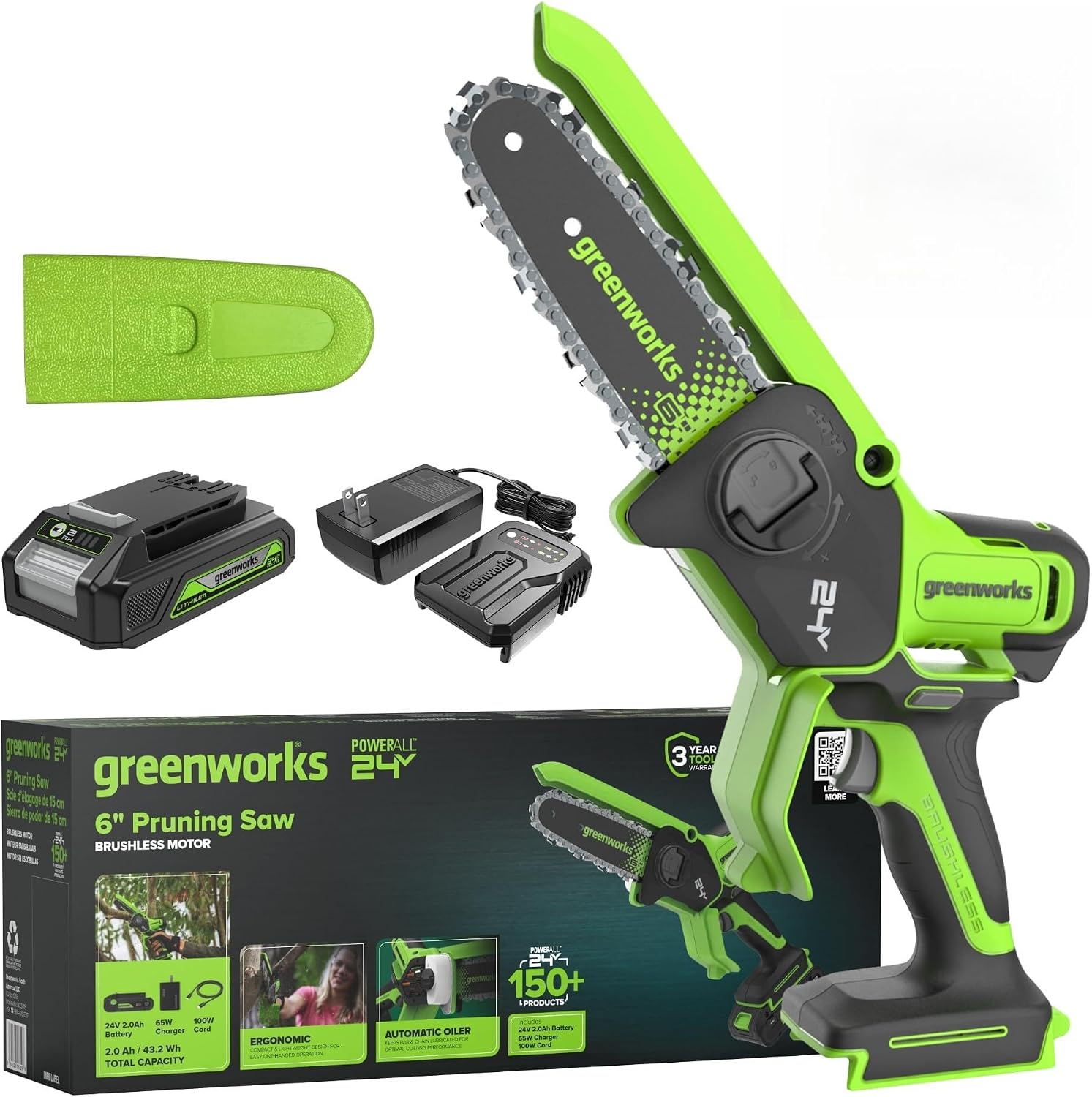
Greenworks CS24L211-00 6-Inch Pruning Chainsaw
A lightweight, battery-powered chainsaw designed for manageable yard tasks like trimming branches and cutting small firewood. Its brushless motor and tool-free tensioning offer a clean, low-maintenance alternative to gas models, making it suitable for casual gardeners and DIYers.
Pros
- Brushless motor provides more power and longer runtime than many 20V alternatives.
- Ultra-lightweight design at 3.4 lbs reduces user fatigue during extended use.
- Tool-free chain tensioning allows for quick and easy adjustments.
- Automatic oiler with transparent window ensures proper lubrication for smoother cuts and tool longevity.
- Compatible with the extensive Greenworks POWERALL 24V tool ecosystem.
Cons
- The 6-inch bar limits it to pruning and small cutting tasks, not suitable for felling trees or heavy-duty work.
- Battery and charger are sold separately, which can increase the total cost.
DEWALT DCCS623B 8-Inch Cordless Pruning Chainsaw
This bare-tool cordless chainsaw is built for light-duty yard work. Its compact, brushless design prioritizes maneuverability and reduced user fatigue, making it a strong option for trimming and pruning in tight spaces. It's best suited for homeowners who already own compatible DEWALT 20V batteries.
Pros
- Exceptionally lightweight and compact design for easy handling.
- High-efficiency brushless motor maximizes battery runtime and durability.
- Integrated tip guard aids stability, especially for upward cuts.
- Auto-oiling system ensures continuous chain lubrication.
- Tool-free chain tensioning simplifies maintenance.
Cons
- Sold as a bare tool, requiring a separate battery and charger purchase.
- The 8-inch bar limits it to smaller pruning and trimming tasks.
Best Pruning Chainsaw Buying Guide
Power Source: Electric vs. Gas-Powered
The fundamental choice when selecting a best pruning chainsaw is between electric and gas-powered models. Battery-powered electric chainsaws have surged in popularity due to their quiet operation, zero direct emissions, and minimal maintenance. They are ideal for residential use, especially in noise-sensitive areas, and for users who prefer a quick start without pull cords. However, they require charged batteries and may have limited runtime for very large jobs. Gas-powered models offer unmatched power and runtime, making them suitable for prolonged, heavy-duty pruning on large properties or in remote areas without power access. The trade-off is higher noise, exhaust fumes, and regular maintenance like oil changes and spark plug replacements.
Consider your typical pruning session length and location. For most homeowners with average-sized yards and occasional tree maintenance, a high-quality battery-electric model like the one featured here provides more than enough power and convenience. For professional arborists or those managing extensive woodlands, the raw power and endurance of a gas model might be necessary. Remember to factor in the cost of additional batteries or fuel and oil into your long-term budget.
Bar Length and Cutting Capacity
The bar length determines the maximum diameter of branch you can cut in a single pass. For pruning chainsaws, bar lengths typically range from 8 to 14 inches. A shorter bar (8-10 inches) offers superior maneuverability and control for precision pruning in tight spaces and is lighter, reducing arm fatigue during overhead work. It’s perfect for fruit trees, shrubs, and light limbing. A longer bar (12-14 inches) increases your reach and allows you to tackle thicker branches, but it also adds weight and can be more cumbersome to handle aloft.
Match the bar length to the largest branch diameter you expect to cut regularly. It’s generally wise to choose a bar that is at least 2 inches longer than the thickest wood you’ll encounter. A model with a 10-inch bar can typically handle branches up to about 8 inches in diameter effectively. For versatility, some systems offer interchangeable bars, allowing you to switch between lengths for different tasks. A well-balanced tool, like many in our top 7, ensures that the weight of a longer bar is managed effectively.
Weight and Ergonomics
Since pruning often involves working at odd angles and above your head, weight and balance are critical. A lighter chainsaw drastically reduces user fatigue and improves control, making your pruning sessions safer and more productive. Look for a powerhead weight under 10 pounds for gas models and even less for battery-electric ones. Ergonomics extend beyond weight to include a comfortable, anti-vibration handle system. Excessive vibration transmitted to your hands can lead to numbness and fatigue; a good pruning chainsaw will have built-in dampeners to minimize this.
The grip design should allow for a secure hold even when wearing gloves. A rear handle designed for a firm two-handed grip is essential for control. Some models feature a wraparound or sculpted handle that distributes pressure points. When evaluating, consider if the controls (like the throttle and chain brake) are easily accessible without adjusting your grip. A tool that feels like an extension of your arm is the goal. For more on ergonomic garden tools, see our hand tools category page.
Safety Features
Safety is non-negotiable with any chainsaw, especially when pruning. The most crucial feature is a low-kickback bar and chain system. Kickback occurs when the moving chain’s tip contacts an object, causing the saw to jerk back toward the operator. A low-kickback chain reduces this risk significantly. An inertia-activated chain brake is equally important; it should automatically stop the chain if kickback is detected or can be manually engaged by a hand guard. Always verify these features are present.
Additional safety considerations include a hand guard that protects your front hand, a chain catcher to prevent a broken chain from flying back, and a throttle interlock that requires two separate actions to engage the chain, preventing accidental starts. For electric models, look for a lock-off switch. No safety feature replaces proper technique and personal protective equipment (PPE)—always wear chainsaw chaps, gloves, eye protection, hearing protection, and a helmet when operating any best pruning chainsaw.
Ease of Maintenance
A chainsaw that is difficult to maintain will quickly become a frustration. Key maintenance tasks include chain tensioning, sharpening, and bar/chain lubrication. Look for tool-free chain tensioning systems, which allow you to quickly adjust the chain snugness with a dial or lever without needing a separate wrench. This is vital, as a loose chain is dangerous and a tight chain wears quickly. Automatic oiling systems that lubricate the bar and chain during use are standard and help prolong the life of these components.
For gas models, consider the ease of accessing the air filter and spark plug. For battery models, check the charging time and battery management indicators. A clear and easy-to-fill oil reservoir is also important. Models designed with clear markings and accessible components, like several in our review, make routine upkeep simple, ensuring your best pruning chainsaw remains reliable season after season.
| Feature | Gas-Powered | Battery-Electric |
|---|---|---|
| Power & Runtime | High power, unlimited runtime with refueling | Good power, limited by battery capacity |
| Noise & Emissions | Loud, produces exhaust fumes | Quiet, zero direct emissions |
| Maintenance | High (engine oil, spark plugs, air filter) | Low (chain/bar care, battery charging) |
| Startup | Pull-cord, can be difficult | Instant, push-button |
| Best For | Heavy-duty, prolonged use, remote areas | Residential use, noise-sensitive areas, quick jobs |
Why You Should Trust Us
Our recommendations are built on a foundation of objective, data-driven analysis. We do not accept payment for reviews or rankings. Our process involves aggregating and scrutinizing detailed product specifications, manufacturer claims, and verified user experiences. We focus on identifying the key performance indicators for best pruning chainsaw tools—such as power-to-weight ratio, safety system effectiveness, and ergonomic design—and evaluate how each model measures up. Our goal is to cut through marketing hype and provide you with clear, comparative insights to inform your purchase.
Transparency is core to our methodology. We clearly state when our analysis is based on specifications and aggregated data versus hands-on testing. For this guide on the best pruning chainsaw of 2026, we have meticulously compared the technical attributes and design philosophies of 7 leading models to present you with a curated, unbiased selection.
Final Thoughts
After evaluating the current market, we have several standout recommendations from our list of 7 top best pruning chainsaw models. For the best overall pruning chainsaw, we recommend a model that excels in balancing power, manageable weight, and comprehensive safety features, making it a versatile choice for a wide range of users. Our top pick provides the reliability and performance needed for most residential and semi-professional pruning tasks.
For those seeking the best value, look for a model that delivers core functionality—a quality low-kickback chain, good ergonomics, and tool-free maintenance—at a very competitive price point. It might forgo some premium features but gets the fundamental job done safely and effectively. If you have specific needs, such as ultra-lightweight design for extensive overhead work or maximum power for the thickest hardwood, there are specialized models that excel in those areas. For other garden cutting tools, consider our review of the best leaf blower and hedge trimmer combo.
Remember, the best pruning chainsaw for you is the one that matches your specific pruning requirements, physical capability, and comfort level. We encourage you to use our buying guide criteria to weigh the options in our comparison table above. Investing in the right tool not only makes your gardening work more efficient but also significantly enhances safety.
Frequently Asked Questions
What is the best pruning chainsaw for 2026?
The “best” best pruning chainsaw depends on your individual needs. Our top overall pick balances power, weight, and safety features for broad appeal. However, the best model for you will be determined by your primary use case (light pruning vs. heavy-duty cutting), preferred power source (battery or gas), and budget. Refer to our detailed buying guide and comparison table to identify the model that aligns with your specific criteria.
Is a pruning chainsaw different from a regular chainsaw?
Yes, pruning chainsaws are specifically designed for trimming and cutting branches, often while working off the ground. They tend to be lighter, more compact, and better balanced for overhead and precision work compared to larger felling and bucking chainsaws. Many feature shorter bars and enhanced safety systems tailored for the unique risks of pruning, such as kickback prevention when the tip might contact other branches.
Can I use a pruning chainsaw to cut down a whole tree?
While a powerful pruning chainsaw with a longer bar could technically fell a small tree, it is not recommended. Felling trees requires specialized techniques, a different balance of power, and often a longer bar for safety and control. Pruning chainsaws are optimized for cutting branches, not for the directional felling of trunks. For tree removal, a standard chainsaw designed for that purpose is the appropriate and safer tool.
How do I maintain my best pruning chainsaw?
Regular maintenance is crucial for safety and longevity. Always keep the chain sharp and properly tensioned (using a tool-free system if available). Ensure the bar and chain lubrication reservoir is filled before each use and check for even oil distribution. Clean the air filter (on gas models) and keep the saw free of sawdust and debris. Store the saw in a dry place, and for battery models, follow the manufacturer’s guidelines for battery charging and storage. For more on tool care, visit our Shovels, Spades & Hoes section for maintenance tips that apply broadly.
What safety gear do I need when using a best pruning chainsaw?
Never operate a pruning chainsaw without proper Personal Protective Equipment (PPE). Essential gear includes: chainsaw chaps or pants to protect your legs; safety glasses or a face shield; hearing protection; heavy-duty, non-slip gloves; and a hard hat, especially when working under branches. Sturdy, non-slip boots are also a must. Safety gear is your last line of defense and is just as important as the safety features built into the saw itself.
About the author
Managing Editor & Buying Guides. Based in Asheville, North Carolina. Carolyn manages the editorial calendar and writes our buying guides. A long-time gardener in the Blue Ridge foothills, she knows how much fall leaf cleanup can wear on a yard, so blowers and vacuums are her specialty.