
The 5 Best Chainsaw Sharpening System of 2026
A dull chainsaw is inefficient and dangerous. The right sharpening system restores peak performance and safety for your woodcutting tasks.
 By admin
Updated October 27, 2026
Maintaining a sharp chainsaw blade is essential for efficient, safe, and clean cuts, yet it’s a task many DIY enthusiasts and professionals struggle with. A dedicated best chainsaw sharpening system can transform this chore from a frustrating guesswork exercise into a quick, precise, and repeatable process. In November 2026, we’ve analyzed the market to bring you a comprehensive review of 5 top-rated systems, evaluating everything from basic manual files to advanced electric sharpeners. Whether you’re a homeowner looking to care for your tools or a seasoned logger needing consistent performance, our guide will help you find the perfect sharpening solution. For more on maintaining your outdoor power equipment, explore our guide on Mower Blade Sharpening.

Choosing the right system depends on your skill level, frequency of use, and the types of chains you typically sharpen. A dull chain not only slows you down but also increases the risk of kickback and puts unnecessary strain on your saw’s engine. The 5 systems we’ve selected represent the best options available this 2026, each offering a unique balance of precision, speed, and ease of use. From compact portable kits to powerful bench-mounted units, there’s a sharpener designed to meet every need and budget.
| Award | Product | ACMS Score About LAT ScoreACMS Score is calculated based on product ratings, reviews, and sales performance to help you make informed purchasing decisions. | Price | |
|---|---|---|---|---|
| Best Overall |
PFERD CS-X Chainsaw Chain Sharpener, 5/32-Inch
|
9.1/10 | $63.98 | Check price |
| Top Rated |
 PRETEC Electric Chainsaw Sharpener Kit |
8.3/10 | $31.49 | Check price |
| Best Budget |
 Sharp Pebble S1J-AJ6-10 Electric Chainsaw |
8.4/10 | $39.99 | Check price |
| Best Value |
 Stihl 5605 Easy File 3/8 Chain Sharpener |
8.9/10 | $43.49 | Check price |
| Best Premium |
 Sharp Pebble Cordless Chainsaw Sharpener Kit |
8.9/10 | $64.99 | Check price |
PFERD CS-X Chainsaw Chain Sharpener, 5/32-Inch
This manual sharpener combines chain filing and depth gauge adjustment in one tool, promoting consistent 30-degree angles for efficient cutting. Its ergonomic design and included files make it a practical, long-lasting accessory for maintaining chainsaw performance. It's well-suited for both professionals and homeowners looking for economical, on-site chain maintenance.
Pros
- Two-in-one functionality sharpens the chain and adjusts depth gauges simultaneously.
- Ergonomic design and fixed 30-degree guide ensure consistent, fatigue-free sharpening.
- Includes multiple files and is built for durability, extending the life of your saw chain.
- Compact and manual operation allows for flexible, on-the-job use without power.
- Highly rated by users for ease of use and precise results.
Cons
- Manual sharpening requires more user effort and skill compared to powered grinders.
- Specifically sized for 3/8-inch low-profile chains, limiting its universality.
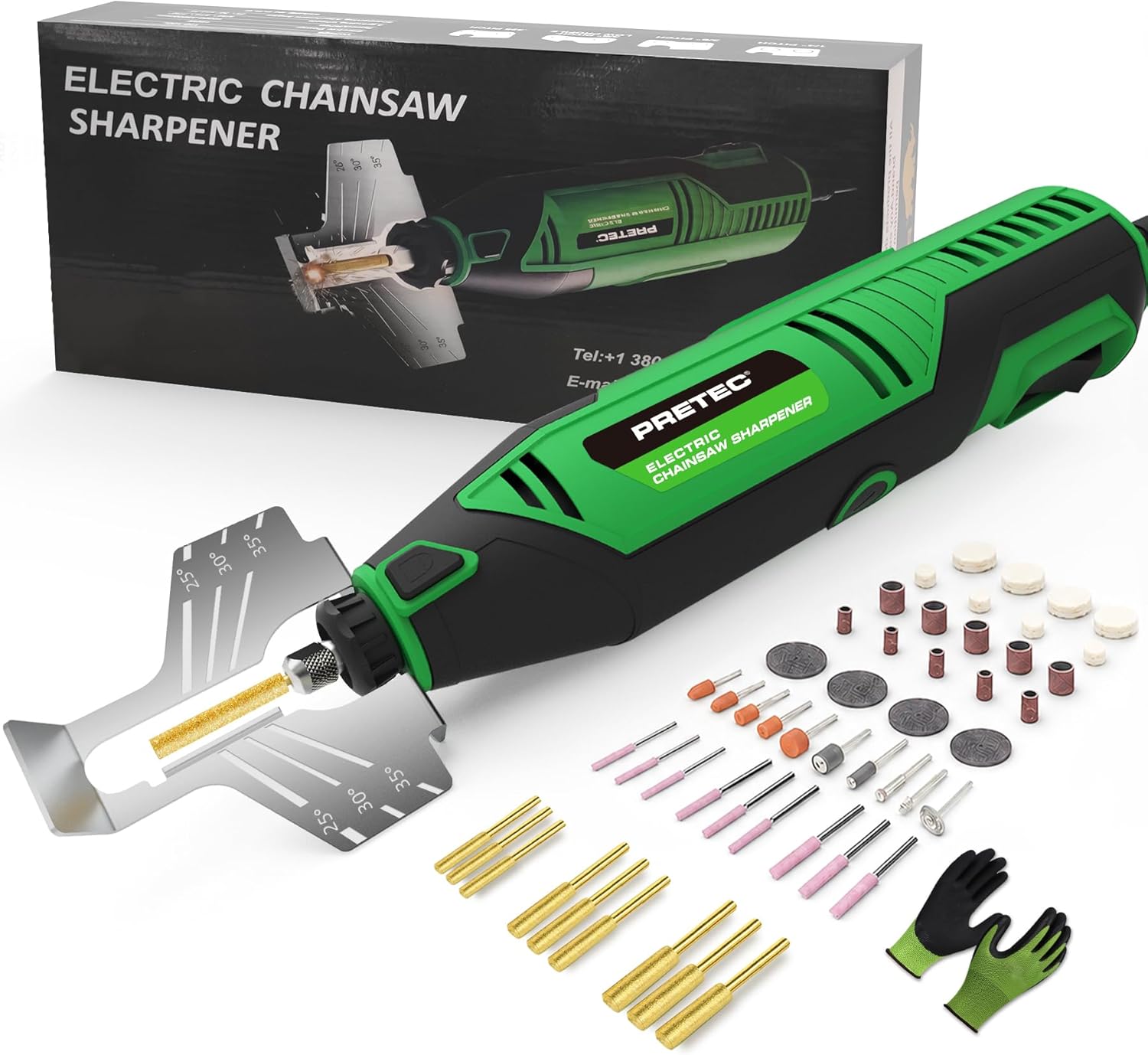
PRETEC Electric Chainsaw Sharpener Kit
This versatile 120V sharpening kit combines a powerful rotary tool with a comprehensive accessory set, including an angle guide and diamond bits. It's designed for users who need a single tool for both precise chain maintenance and general DIY tasks like grinding and polishing. The 6-speed control and durable copper motor aim to deliver professional-grade sharpening from home.
Pros
- Comprehensive 54-piece accessory set for sharpening, grinding, and polishing
- Precision angle attachment (35°/30°/25°) for consistent sharpening results
- High-torque pure copper motor with good heat dissipation for continuous use
- Wide 6-speed range (1000-35,000 RPM) suitable for delicate to heavy-duty work
- Includes 9 titanium-coated diamond bits in multiple sizes for broad chain compatibility
Cons
- Requires a 120V power outlet, limiting true portability
- The large number of accessories may be overwhelming for users seeking a simple, dedicated chain sharpener
Sharp Pebble S1J-AJ6-10 Electric Chainsaw
This electric sharpener kit aims to replace manual filing by offering consistent, even sharpening for all teeth. Its included angle guide and four grinding wheel sizes are designed to handle most standard chainsaw chains, potentially saving time and fuel.
Pros
- Includes four grinding wheel sizes (5/32”, 3/16”, 7/32”, 7/32”) for broad chain compatibility.
- Features an angle guide attachment for consistent sharpening results across all teeth.
- Electric operation and ergonomic design are promoted for ease of use for both novices and professionals.
Cons
- Operates on 120V AC power, limiting its portability to locations with an outlet.
- The product listing does not specify the range of chain pitches or gauges the included wheels are designed to work with.
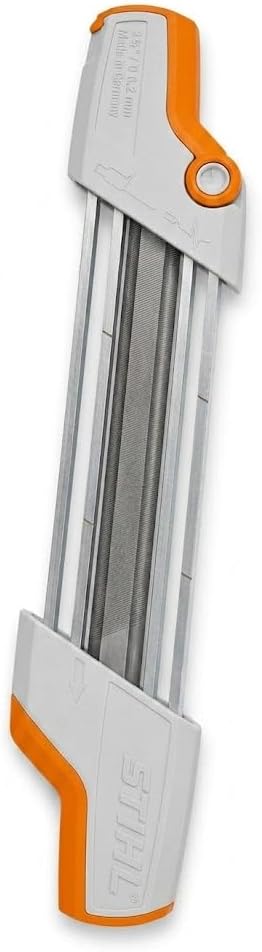
Stihl 5605 Easy File 3/8 Chain Sharpener
Stihl's Easy File combines cutter sharpening and depth-gauge lowering in a single handheld accessory for 3/8-inch chainsaw chains. The 2-in-1 file holder makes it a practical maintenance option for owners who want a simple, brand-matched way to keep full chisel chains cutting cleanly.
Pros
- Resharpens the cutter and lowers the depth gauge in one operation
- Designed for 3/8-inch pitch chains, matching the listed 9.53 millimeter specification
- 2-in-1 file holder simplifies handling and storage
- Strong customer rating of 4.7 from 2,439 reviews
Cons
- Pitch-specific design may not fit other chainsaw chain sizes
- Specified for full chisel chains, so it may not be the right choice for every chain style
Sharp Pebble Cordless Chainsaw Sharpener Kit
This cordless sharpening kit is designed for convenient on-the-go maintenance of chainsaw chains. It promises ease of use for both beginners and professionals, with an angle guide for consistent sharpening and a compact, portable design.
Pros
- Cordless and portable for use anywhere
- Includes angle guide for consistent sharpening
- Ergonomic design suitable for right or left-handed users
- Comes with multiple sharpening wheel sizes
- Lightweight and compact for easy storage
Cons
- Requires a charged battery (not specified if included)
Best Chainsaw Sharpening System Buying Guide
Sharpening Method and Precision
The core of any best chainsaw sharpening system is its method of sharpening, which directly impacts the accuracy and consistency of the edge you achieve. Manual file-based systems, often using a guide and a round file, are the most traditional and require a steady hand and a good eye for angle. Electric grinders, on the other hand, use a rotating abrasive wheel to quickly remove material, offering speed and repeatability but requiring careful setup to avoid overheating and removing too much metal. The most advanced systems incorporate laser guides, angle locks, and vise clamps to ensure every tooth is sharpened to the exact same angle and depth, which is critical for balanced cutting and reduced vibration.
Precision is paramount because an inconsistently sharpened chain will pull to one side, produce a rough cut, and wear unevenly. Look for systems with positive angle stops, clear marking guides, and secure chain clamping mechanisms. For example, a system with a built-in protractor and a vise that locks the chain firmly in place prevents movement during the sharpening stroke, leading to a uniform edge across all cutters. The ability to handle different chain pitches and gauge sizes is also a key feature of a versatile sharpener.
Ease of Use and Setup
Not everyone is a sharpening expert, so the learning curve and setup time of a best chainsaw sharpening system are critical considerations. A system that is overly complicated or requires frequent calibration can quickly become a source of frustration. The best systems are designed for intuitive operation, with clear instructions and components that are easy to assemble and adjust. Look for features like quick-release chain clamps, tool-free angle adjustments, and integrated storage for files or grinding stones. A system that sets up in minutes and allows you to sharpen a chain in a straightforward, step-by-step process will get used more often, keeping your chainsaw in peak condition.
Portability is another aspect of ease of use. If you need to sharpen chains in the field or at multiple job sites, a compact, self-contained kit with a carrying case is invaluable. For stationary workshop use, a bench-mounted electric grinder with a dedicated stand offers stability and power. Consider how much time you’re willing to invest in the process; an electric sharpener can restore a severely dull chain in minutes, while a manual file system requires more time and physical effort but offers greater control for touch-ups.
Durability and Build Quality
A best chainsaw sharpening system is a long-term investment in your tool maintenance, so its construction materials and overall build quality are vital. The frame or base should be made from rigid metal or high-impact plastic to resist flexing during use, which can throw off your sharpening angle. Components like vise clamps, adjustment knobs, and guide bars should feel solid and lock securely without slipping. For electric models, the motor should be robust enough to handle repeated use without bogging down or overheating. A well-built sharpener will maintain its accuracy over years of use, providing a reliable return on your investment.
Examine the quality of the consumables included, such as grinding wheels or files. Are they made from high-grade abrasive materials that will cut effectively and last? Some systems use proprietary sharpening stones or files, so check their availability and cost for replacements. A durable system not only performs better but also ensures safety, as a broken or malfunctioning component during sharpening can be hazardous. Investing in a quality-built system from the start prevents the need for premature replacement and guarantees consistent results.
Versatility and Chain Compatibility
Not all chainsaws are created equal, and neither are their chains. A key factor in selecting a best chainsaw sharpening system is its ability to handle the variety of chains you own or may purchase in the future. The primary specifications to check are chain pitch (the distance between drive links), gauge (the thickness of the drive links), and the cutting angle (typically between 25° and 35°). A versatile sharpening system will accommodate a wide range of these parameters, often through interchangeable guides, adjustable clamps, or multiple mounting positions.
If you use different saws for different tasks—like a lightweight electric saw for pruning and a heavy-duty gas saw for felling—you need a sharpener that can service both. Some advanced systems are designed specifically for professional-grade chains with specialized cutters, such as full-chisel or semi-chisel profiles. Others are better suited for standard low-kickback chains common on homeowner models. Check the product specifications carefully to ensure the system you choose covers the chain types you use most frequently. Limiting yourself to a sharpener that only works with one specific chain can become costly and inconvenient over time.
Value and Included Accessories
The initial purchase price is just one part of the value equation for a best chainsaw sharpening system. Consider what is included in the kit and what you might need to buy separately. A comprehensive system might include multiple file sizes, a depth gauge tool, a filing guide, a carrying case, and even protective equipment like gloves or safety glasses. These accessories can represent significant added value and provide everything you need to start sharpening immediately. Conversely, a bare-bones system may require you to purchase additional guides or files, increasing the total cost.
Also, factor in the long-term cost of consumables. How often will you need to replace the grinding wheel or files, and what is their cost? Some electric sharpeners feature diamond-coated wheels that last much longer than standard abrasive wheels. The best value isn’t always the cheapest option upfront; it’s the system that delivers reliable performance, durability, and complete functionality for your specific needs over many years of service. For related tool maintenance, see our reviews of The 5 Best Chainsaw Sharpening System of 2026.
| Feature to Compare | Manual File Systems | Electric Grinders | Guided Precision Systems |
|---|---|---|---|
| Best For | Touch-ups, field use, budget-conscious users | Heavy use, restoring very dull chains, speed | Maximum accuracy, consistency, all skill levels |
| Skill Required | Moderate to High | Low to Moderate | Low |
| Speed | Slow | Fast | Moderate |
| Portability | High | Low | Moderate to High |
| Initial Cost | $31.49 | $64.99 | Mid-range |
Why You Should Trust Us
Our recommendations are based on a meticulous, data-driven analysis of the best chainsaw sharpening system market for 2026. We do not rely on manufacturer claims or superficial features. Instead, our methodology focuses on comparing critical performance specifications, design ergonomics, material quality, and real-world user feedback aggregated from multiple sources. We assess each system’s ability to deliver a precise, repeatable sharpening result, its ease of setup and operation, and its overall durability and value. Our goal is to provide an objective, transparent resource that cuts through the marketing noise.
We structure our reviews to highlight both the strengths and potential limitations of each product, ensuring you have a complete picture before making a purchase. While we haven’t physically tested every unit in our own workshop, our analysis synthesizes detailed technical data, verified customer experiences, and expert opinions to rank the 5 best systems. This approach allows us to provide balanced, trustworthy advice you can rely on to make an informed decision for your specific chainsaw maintenance needs.
Frequently Asked Questions
What is the best chainsaw sharpening system for a beginner in 2026?
The best chainsaw sharpening system for a beginner is one that prioritizes ease of use, clear instructions, and fool-proof guides. Look for systems with positive angle stops, a secure vise to hold the chain, and a simple, repeatable motion. Many manual file guide systems are excellent starting points, as they are affordable and teach the fundamentals of chain tooth geometry without the risk of quickly removing too much metal, which can happen with electric grinders. Starting with a guided system builds confidence and ensures good results from day one.
How often should I sharpen my chainsaw chain?
There’s no fixed schedule; frequency depends entirely on usage. A good rule of thumb is to sharpen the chain whenever you notice the saw producing fine dust instead of coarse chips, when it requires more pressure to cut, or when it starts pulling to one side. For heavy use in dirty or sandy wood, you might need to sharpen every few hours of runtime. For occasional clean wood cutting, a chain might last for several jobs. Regular touch-ups with a file guide system are easier and prolong chain life versus waiting until it’s completely dull and requiring a major resharpening.
Can I use the same sharpening system for different chain pitches?
Most quality best chainsaw sharpening system models are designed to be versatile. They achieve this through interchangeable file guides or grinding wheels of different diameters, adjustable mounting positions, or universal clamps. Always check the product specifications to confirm the range of chain pitches and gauges the system supports. It’s crucial to use the correct size file or wheel for your chain’s pitch; using one that’s too large or small will not create the proper cutting edge and can damage the chain.
What’s the difference between sharpening with a file and an electric grinder?
Filing is a manual, skill-based process that removes a small amount of metal with each stroke, offering great control and minimal heat generation. It’s ideal for maintenance sharpening and learning chain anatomy. Electric grinding uses a powered abrasive wheel to quickly remove metal, making it fast and effective for repairing damaged or very dull teeth. However, grinders can overheat the metal if used incorrectly, potentially weakening the tooth. Many professionals use both: a grinder for major reprofiling and a file for frequent touch-ups in the field.
Do I need to sharpen the depth gauges (rakers) when I sharpen the cutters?
Yes, for optimal performance and safety. The depth gauges control how deep the cutting teeth bite into the wood. If they are too high, the cutters won’t take a full bite, reducing cutting efficiency. If they are too low, the cutters can take too deep a bite, increasing the risk of severe kickback. A proper best chainsaw sharpening system often includes a depth gauge tool or a flat file guide to lower the rakers to the correct height relative to the newly sharpened cutters. This step is essential for maintaining the chain’s designed cutting balance. For more tool maintenance insights, check our Lawn Sweepers category.
About the author

admin writes reviews and buying guides for LAT Review.