
TempleTool R-240 Review: A Dual-Purpose Japanese Pull Saw
The TempleTool R-240 is a versatile Japanese pull saw offering both rip and crosscut teeth on a single blade, designed for precise joinery and dimensioning tasks with a focus on quality craftsmanship.
 By Jake Lindgren
Updated October 26, 2026
Quick Verdict
8.9/10This versatile dual-purpose saw offers rip and crosscut teeth on a single blade, making it a capable generalist for joinery and dimensioning lumber. Its premium handle and Japanese steel construction are backed by consistently positive user feedback. It's well-suited for woodworkers seeking a high-quality, lightweight hand saw for precise cuts.
What we like
- Dual-purpose blade handles both rip and crosscut tasks efficiently.
- High-quality Japanese steel maintains sharpness for clean, precise cuts.
- Lightweight pull-stroke design allows for thin-kerf, accurate, and less fatiguing use.
- Premium wingnut wood handle with brass components offers a comfortable, durable grip.
- Consistently high user rating indicates reliable satisfaction and performance.
Watch out for
- Limited warranty may concern some users seeking long-term coverage.
For woodworkers seeking a blend of precision, versatility, and traditional craftsmanship in a hand tool, the TempleTool R-240 presents a compelling option. This Japanese pull saw, or ryoba, is designed as a general-purpose tool capable of handling a wide range of tasks from cutting stock to size to executing joinery like dovetails and tenons. It is particularly suited for hobbyists and professionals who value a lightweight, accurate saw that performs on the pull stroke, offering a different experience from Western push saws.

At its core, the TempleTool R-240 aims to combine Western and Japanese design philosophies into a high-quality tool that is both beautiful and functional. The bottom line is that this saw offers a dual-purpose blade in a well-crafted package, making it a strong contender for anyone looking to add a capable and precise Japanese saw to their toolkit without needing multiple specialized tools.
Prime Temple Tool R-240 9.5-Inch Ryoba Japanese Pull Saw







As an Amazon Associate we earn from qualifying purchases. Product prices and availability are accurate as of the date/time indicated.
TempleTool R-240 at a Glance
| Specification | Detail |
|---|---|
| Model | R-240 |
| Blade Type | Double-edge (Ryoba) Japanese Pull Saw |
| Blade Teeth | Rip-cut (with grain) and Crosscut (across grain) |
| Blade Material | High-grade Japanese Steel (High Carbon Steel) |
| Handle Material | Solid Wingnut Wood (in walnut family) |
| Handle Components | Brass |
| Power Source | Hand Power |
| Special Features | Lightweight, Pull-stroke cutting |
| Included Components | Case |
| Warranty | Limited Warranty |
| Manufacture Origin | Made in Japan |
Design and Build
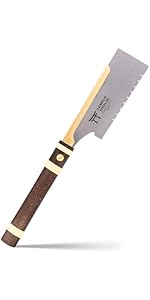
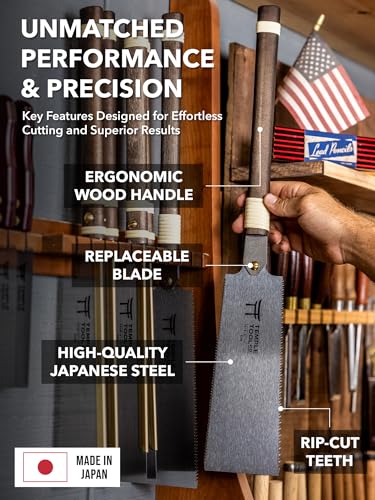
The design of the TempleTool R-240 immediately communicates a focus on quality materials and ergonomics. The handle is crafted from solid Wingnut wood, which is noted as being in the walnut family, giving it a dark brown finish complemented by brass components. This combination is intended to deliver both aesthetic appeal and a durable, comfortable grip during extended use. The handle design is a key part of the pull-saw operation, providing a secure point of control for the precise, drawing motion.
The blade itself is the centerpiece of the tool’s design. As a ryoba saw, it features two distinct sets of teeth on opposite edges of a single, thin blade. One side is configured with rip teeth for cutting parallel to the wood grain, while the other side has crosscut teeth for cutting across the grain. This dual-purpose design eliminates the need to switch between two separate saws for different fundamental cuts. The blade is made from high-grade Japanese steel, a material renowned in tool manufacturing for its ability to hold a sharp edge. The entire tool is noted as being lightweight, a characteristic enabled by the thin-kerf blade and the pull-stroke cutting action which requires less force than a push stroke. The saw comes with a case for storage and protection. For more information on different types of hand saws, you can explore our guide on the best small hand saws.
Performance and Features
Pull-Stroke Cutting Action
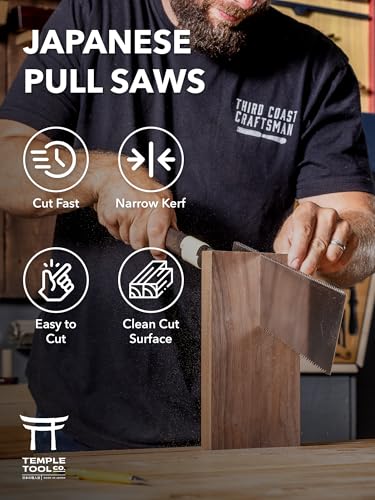
The fundamental performance characteristic of the TempleTool R-240 is its operation as a pull saw. Unlike Western saws that cut on the push stroke, this saw cuts on the pull stroke. This technique allows the blade to be made much thinner, as it is under tension during the cutting action rather than compression. The result is a narrower kerf (the width of the cut), which translates to less wasted material, less effort required per stroke, and the potential for more precise and controlled cuts. This action is described as providing a smooth, easy cutting experience suitable for various skill levels.
Dual-Purpose Blade Functionality
The ryoba design is the core of this saw’s versatility. The rip teeth are designed to efficiently remove material when cutting along the length of a board, such as when resawing or cutting tenon cheeks. The crosscut teeth on the opposite edge are designed to cleanly sever wood fibers when cutting across the grain, ideal for cutting boards to length or width. This makes the R-240 a true general-purpose saw, capable of handling stock dimensioning as well as more delicate joinery work like dovetails and tenons, as stated by the manufacturer. Having both functions in one tool simplifies a woodworker’s kit and reduces setup time.
Craftsmanship and Heritage
A significant feature highlighted by Temple Tool Co. is the saw’s provenance. It is handcrafted in a historic Japanese city by artisans with a heritage of over a century in saw manufacturing. This “Made in Japan” designation is associated with a global reputation for excellence in woodworking tool manufacturing, implying a level of meticulous craftsmanship and quality control. The company’s mission, founded by expert woodworker Chris Schoenberg, is to blend this Japanese craftsmanship with Western style and quality, aiming to deliver exceptional performance at what is considered an honest price point.
Maintenance and Running Costs
Maintenance for a saw like the TempleTool R-240 primarily revolves around blade care. The high-grade Japanese steel is noted for maintaining long-lasting sharpness, which should reduce the frequency of sharpening compared to some other materials. However, like all cutting tools, the teeth will eventually dull with use. The manufacturer does not specify recommended sharpening intervals or methods, so users should refer to general best practices for maintaining Japanese pull saw teeth, which can differ from sharpening Western saws. Proper storage in the included case will help protect the thin blade from damage and rust.
Running costs are minimal as the tool is entirely manual, requiring no batteries, fuel, or electricity. The only potential ongoing cost would be for professional sharpening services or the purchase of specialized sharpening tools if the user chooses to perform that maintenance themselves. The warranty coverage is listed as a limited warranty, though specific terms and duration are not detailed in the provided data. This could be a consideration for long-term ownership, as the level of coverage is not explicitly defined. For insights into other precision woodworking tools, consider reading our review of the best Japanese hand saw for wood.
What Owners Say
Owner feedback for the TempleTool R-240 is overwhelmingly positive, as reflected in its high rating. The vast majority of reviews are top-tier, indicating a high level of satisfaction with the product’s performance and quality. Users consistently praise the saw for its sharpness out of the box, the ease and accuracy of cutting due to the pull-stroke design, and the quality feel of the wooden handle and brass fittings. The dual-purpose blade receives positive remarks for its versatility in handling both rip and crosscut tasks effectively.
The rating distribution shows that critical reviews are a small minority. The minimal number of lower-star reviews suggests that any issues encountered are not widespread. Common points of praise from the collective owner experience align with the manufacturer’s claims: effortless and accurate cutting, a comfortable and premium handle, and excellent overall value for the level of craftsmanship provided. This consensus from a substantial number of users strongly supports the saw’s reputation as a reliable and high-performing tool.
Pros and Cons
Pros
- Versatile dual-purpose blade for rip and crosscut tasks
- High-quality Japanese steel maintains sharpness
- Lightweight pull-stroke design reduces user fatigue
- Thin-kerf blade allows for precise, clean cuts
- Premium wingnut wood and brass handle offers comfort and durability
- Consistently high user satisfaction ratings
- Includes a protective case for storage
Cons
- Limited warranty details may not satisfy all buyers
- Blade may be delicate due to thin profile, requiring careful handling
- Pull-stroke technique may require adjustment for users accustomed to Western push saws
- Specific sharpening instructions or services are not detailed
Who Should Buy It (and Who Should Skip It)
The TempleTool R-240 is an excellent choice for woodworkers of all levels who need a precise, general-purpose hand saw. It is ideal for hobbyists looking to step up from basic tools, DIY enthusiasts tackling furniture projects, or even professionals wanting a reliable ryoba for joinery and quick dimensioning cuts. Its lightweight nature and pull-stroke action make it suitable for users who may find pushing a traditional saw tiring or who need extreme control for detailed work. Anyone who appreciates tool aesthetics and the heritage of Japanese craftsmanship will likely find this saw particularly rewarding.
This saw might not be the best fit for users who primarily perform heavy-duty demolition or rough cutting of thick, wet, or nailed lumber, as the thin blade is designed for precision work. Those who strongly prefer the feel and heft of Western push saws and do not wish to adapt to a pull-stroke technique may also want to stick with their familiar tools. Additionally, if a comprehensive, long-term warranty is a primary deciding factor, the limited nature of the warranty on this product could be a drawback, and such buyers should seek clarification from the manufacturer. For a broader look at saw options, visit our hand saws category page.
Final Verdict
The TempleTool R-240 successfully delivers on its promise of combining quality, versatility, and traditional craftsmanship. As a Japanese ryoba pull saw, it offers a distinct and efficient cutting experience that can enhance precision and reduce effort for a wide array of woodworking tasks. The dual-edged blade effectively serves as two saws in one, handling both rip and crosscut duties with competence, making it a fantastic space-saving and cost-effective option for a toolkit. The attention to material quality—from the Japanese steel blade to the wingnut wood handle—is evident and contributes to both its performance and its aesthetic appeal.
Backed by overwhelmingly positive owner feedback, the R-240 establishes itself as a reliable and highly-regarded tool in its category. While the specifics of its limited warranty could be more transparent, the saw’s design, performance, and construction quality suggest a product built to last. For anyone seeking a high-quality, versatile Japanese pull saw that excels in joinery and precise dimensioning, the TempleTool R-240 is a compelling choice that merits strong consideration. It embodies a thoughtful fusion of Eastern manufacturing heritage and Western design sensibility, resulting in a tool that is as much a pleasure to use as it is effective.
FAQs
What is the difference between a pull saw and a push saw?
A pull saw, like the TempleTool R-240, cuts on the drawing (pulling) stroke toward the user. This allows the blade to be thinner and under tension during the cut, creating a narrower kerf and often requiring less effort. A push saw, common in Western woodworking, cuts on the pushing stroke away from the user, typically requiring a thicker, stiffer blade to resist buckling.
Can the TempleTool R-240 cut both with and across the grain?
Yes, that is its primary design feature. As a ryoba saw, it has two separate sets of teeth on one blade. One edge has rip teeth optimized for cutting parallel to the wood grain (e.g., resawing), and the opposite edge has crosscut teeth for cutting perpendicular to the grain (e.g., cutting a board to length). You simply flip the saw to use the appropriate teeth for the task.
Is this saw suitable for a beginner?
Absolutely. The manufacturer describes it as perfect for all ages and skill levels. The pull-stroke action is often found to be more intuitive and easier to control for beginners than a push stroke, as it engages larger back muscles and allows for better sighting of the cut line. Its lightweight design and sharp blade also contribute to an easier learning curve.
How do I maintain and sharpen this saw?
The manufacturer states the blade is made from high-grade Japanese steel that maintains long-lasting sharpness. For maintenance, store it in the provided case to protect the teeth. Specific sharpening instructions are not listed in the provided data. Sharpening Japanese pull saw teeth typically requires specialized files and techniques different from Western saws; many users opt for professional sharpening services when needed.
Featured In
About the author
Contributor, Seasonal & Snow Tools. Based in Duluth, Minnesota. Jake has cleared long Minnesota driveways every winter for most of his adult life and has strong opinions about shovels and pushers. He writes about snow removal and cold-weather yard work.