
The 8 Best Home Chainsaw of 2026
Home cutting jobs call for a chainsaw that feels balanced, cuts smoothly, and stays easy to handle. 8 top picks for November 2026 can help you choose the right best home chainsaw for dependable work around the house.
 By Jake Lindgren
Updated October 27, 2026
Choosing the right Best Home Chainsaw matters because the best tool should feel safe, manageable, and capable of handling the yard work you actually do. Whether you are trimming storm-damaged limbs, cutting firewood, or clearing small trunks after seasonal cleanup, this guide helps you compare the most useful options without guesswork.

In this roundup of 8 models, we focus on the practical details that matter most for homeowners, from cutting performance to ease of maintenance. If you also want to compare related saw categories, our Chainsaws & Saws category is a helpful place to start.
| Award | Product | ACMS Score About LAT ScoreACMS Score is calculated based on product ratings, reviews, and sales performance to help you make informed purchasing decisions. | Price | |
|---|---|---|---|---|
| Top Rated |
Husqvarna 120 Mark III 16-Inch Gas Chainsaw
|
8.3/10 | $219.99 | Check price |
| Best Overall |
 EGO CS1613 16-Inch Chain Saw |
8.9/10 | $299.00 | Check price |
| Also Great |
 Husqvarna Power Axe 350i 18-Inch Battery Chainsaw |
8.3/10 | $479.99 | Check price |
| Best Premium |
 Greenworks 80V 18-Inch Brushless Cordless Chainsaw |
8.4/10 | $349.99 | Check price |
| Also Great |
 SENIX CSX6-M 16-inch Chainsaw |
7.8/10 | $159.00 | Check price |
| Most Popular |
 SENIX CSX6-M1 60V 18-Inch Chainsaw |
7.8/10 | $169.00 | Check price |
| Best Value |
 EGO CS1611 16-Inch Cordless Chainsaw |
8.8/10 | $249.00 | Check price |
| Best Budget |
 DEWALT DCCS623B 8-Inch Cordless Pruning Chainsaw |
8.6/10 | $145.60 | Check price |
Husqvarna 120 Mark III 16-Inch Gas Chainsaw
A lightweight 16-inch gas chainsaw built for home and garden tasks like cutting firewood and limbing. It's designed for easier starting and handling, with features like an air purge system and LowVib technology to reduce operator fatigue.
Pros
- Air purge system and combined choke/stop control aim to simplify starting and reduce engine flooding.
- LowVib technology is intended to lower vibration for reduced operator fatigue during use.
- Air Injection centrifugal cleaning system helps protect the engine by removing larger debris before it reaches the air filter.
- Inertia-activated chain brake is a standard safety feature to help reduce kickback injury risk.
Cons
- As a gas-powered tool, it requires fuel mixing and regular engine maintenance.
- At 10.7 pounds, it may be heavier than some electric or battery-powered models for similar tasks.
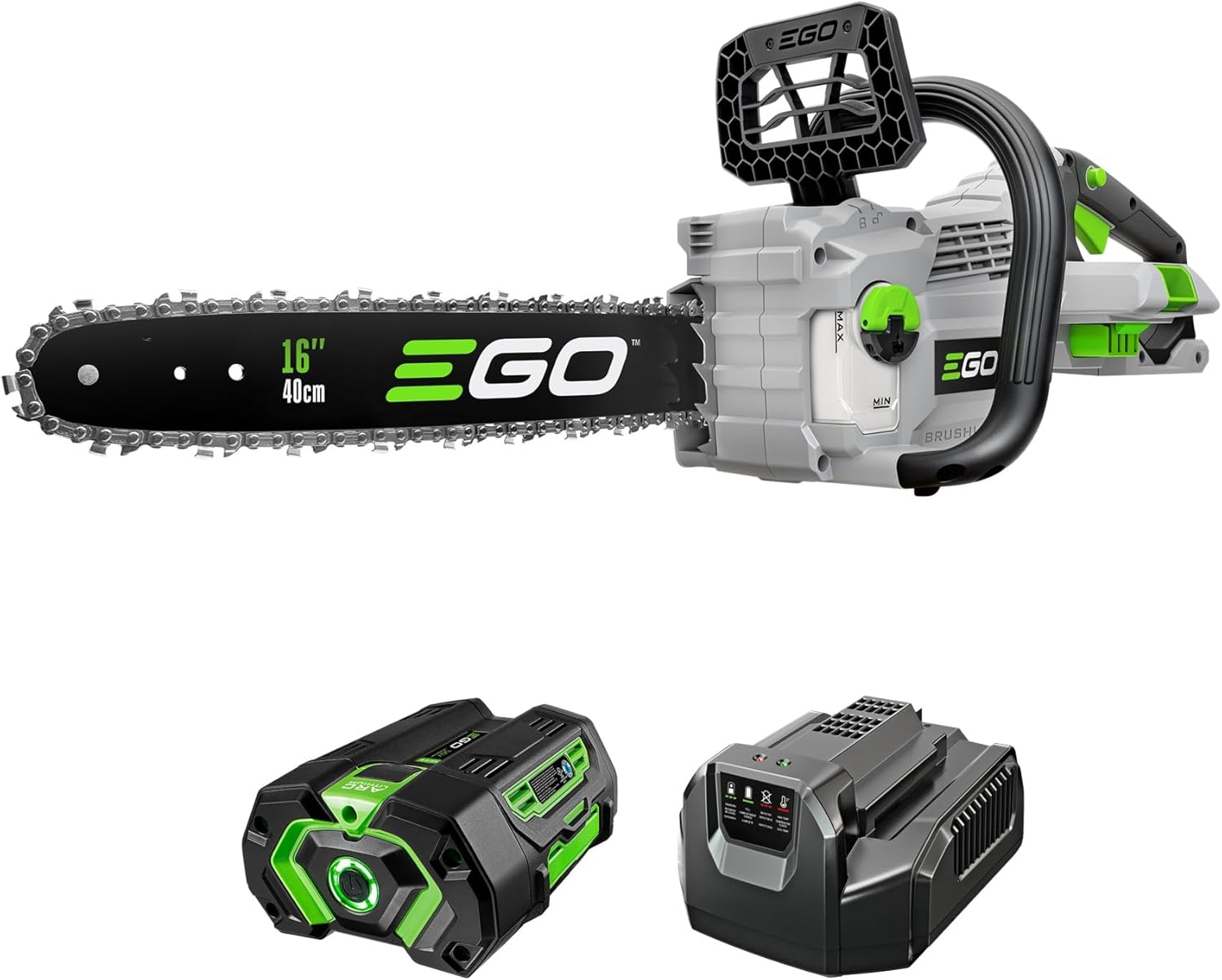
EGO CS1613 16-Inch Chain Saw
This EGO cordless chainsaw pairs a brushless motor with a 16-inch bar, making it a practical fit for homeowners who want gas-like cutting power without the fumes or noise. It includes a 4.0Ah battery and charger, plus tool-free chain tensioning and automatic oiling for easier upkeep.
Pros
- Brushless motor is rated at gas-like power equivalent to a 40cc chainsaw
- Includes a 4.0Ah battery and charger
- Tool-free chain tensioning makes adjustments quick and simple
- Automatic oiling helps keep the chain lubricated during use
- Metal bucking spikes and kickback brake add control and safety
Cons
- Heavier than some compact cordless saws at 20.9 pounds
Husqvarna Power Axe 350i 18-Inch Battery Chainsaw
A cordless, all-in-one kit designed for homeowners tackling yard maintenance like pruning and cutting firewood. It prioritizes convenience with a lightweight, battery-powered design and a tool-less chain tensioner, while its brushless motor and boost mode aim to deliver power competitive with some gas models.
Pros
- Complete kit includes saw, battery, and charger
- Lightweight design reduces user fatigue during operation
- Tool-less chain tensioning system for easy adjustments
- Boost mode provides a temporary 25% power increase
- Equipped with a durable and efficient brushless motor
Cons
- Battery runtime is dependent on the included single battery capacity
Greenworks 80V 18-Inch Brushless Cordless Chainsaw
This 80V cordless chainsaw leverages brushless motor technology to deliver gas-comparable power for demanding tasks like tree felling and limbing. It offers significant user-friendly advantages, including push-button start and an automatic oiler, making it a strong contender for professionals seeking a cleaner, quieter alternative.
Pros
- Powerful brushless motor provides torque comparable to a 42cc gas model.
- Long runtime capable of up to 150 cuts on 4x4 lumber per charge.
- User-friendly features like push-button start and automatic chain oiling.
- Quiet, fume-free operation with no need for gas, spark plugs, or starter ropes.
- Part of a large 80V ecosystem with over 75 compatible tools.
Cons
- The included 2.0Ah battery may limit continuous runtime for very large jobs.
- At 18 inches, the bar length is fixed and may be less versatile for smaller pruning tasks.
SENIX CSX6-M 16-inch Chainsaw
A 60V cordless chainsaw built around a 16-inch Oregon bar and a brushless motor. It is aimed at pruning, branch trimming, and light firewood cutting, with automatic oiling, tool-free tensioning, and ECO mode for more controlled use.
Pros
- 60V battery power with a brushless motor for strong cordless cutting performance.
- 16-inch Oregon bar and chain suited to pruning, branch trimming, and firewood.
- Automatic oiling and tool-free tensioning make upkeep easier.
- Includes a 4.0Ah battery and charger.
Cons
- At 14 pounds, it is not especially light for a cordless saw.
SENIX CSX6-M1 60V 18-Inch Chainsaw
This SENIX cordless chainsaw pairs a 60V battery system with an 18-inch Oregon bar for pruning, branch trimming, and general yard cutting. It stands out for its brushless motor, automatic oiling, tool-free tensioning, and included battery and charger, making it a practical pick for users who want cordless convenience with stronger cutting performance.
Pros
- 18-inch Oregon bar supports pruning, branch trimming, and cutting firewood.
- Brushless motor is rated to extend runtime compared with conventional battery chainsaws.
- Includes a 4.0Ah battery and charger, so it is ready to use out of the box.
- Tool-free tensioning and automatic oiling simplify upkeep.
- ECO Mode can help conserve energy on lighter pruning jobs.
Cons
- At 16 pounds, it is relatively heavy for a cordless saw.
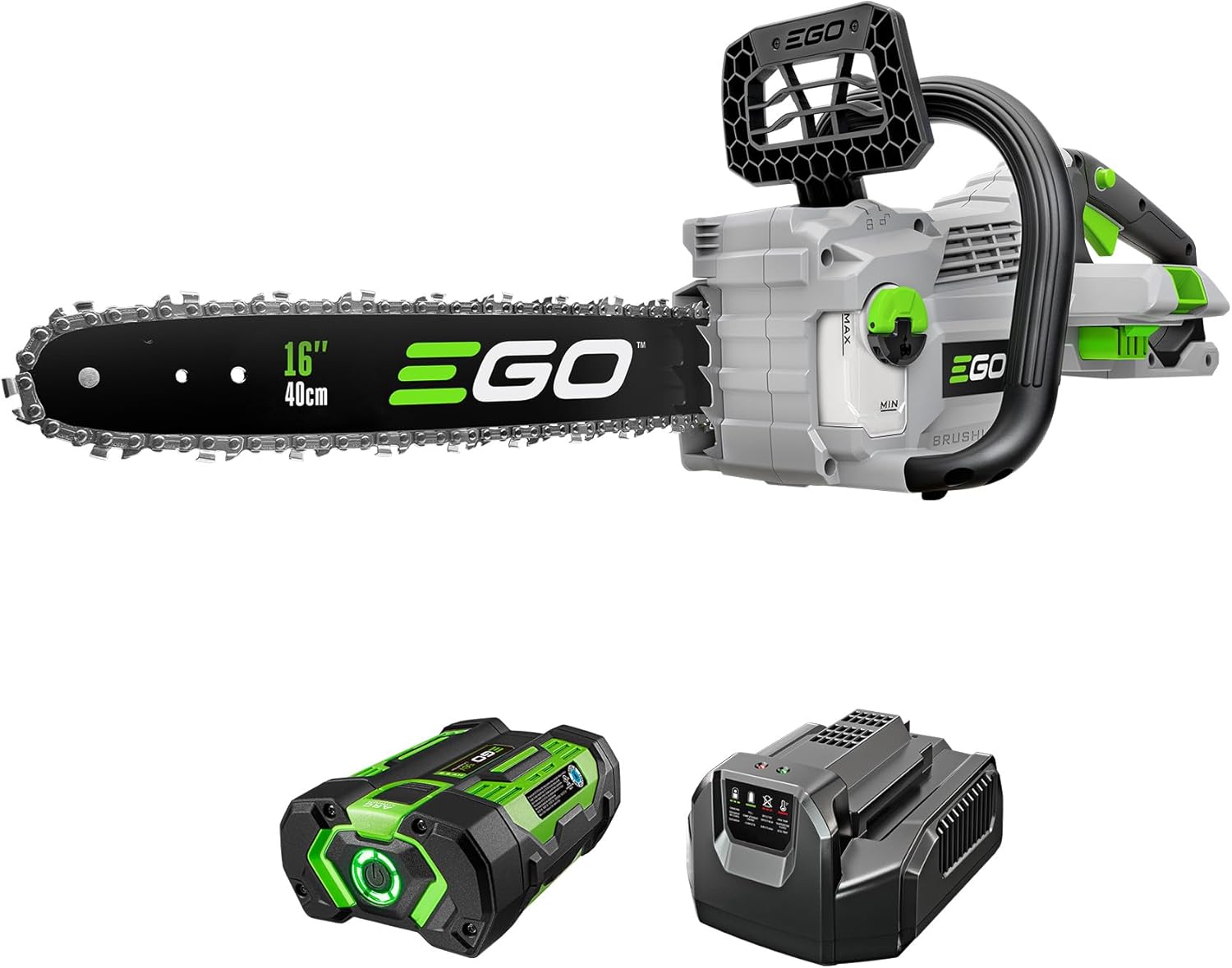
EGO CS1611 16-Inch Cordless Chainsaw
This 56V battery-powered chainsaw offers a gas-like experience without the noise or fumes. Its brushless motor matches the power of a 40CC gas model, and the tool-free tensioning system simplifies adjustments. It's a strong choice for homeowners seeking a clean, convenient alternative to gas-powered tools.
Pros
- Power equivalent to a 40CC gas chainsaw for robust cutting
- Cordless and quiet operation eliminates fumes and gas mixing
- Tool-free chain tensioning system for easy maintenance
- Automatic oiling with a spill-free reservoir
- High user rating of 4.6 stars based on 667 reviews
Cons
- Battery runtime is finite, requiring recharging or spare batteries for extended jobs
- At 9 pounds, it may be heavier than some electric competitors
DEWALT DCCS623B 8-Inch Cordless Pruning Chainsaw
This bare-tool cordless chainsaw is built for light-duty yard work. Its compact, brushless design prioritizes maneuverability and reduced user fatigue, making it a strong option for trimming and pruning in tight spaces. It's best suited for homeowners who already own compatible DEWALT 20V batteries.
Pros
- Exceptionally lightweight and compact design for easy handling.
- High-efficiency brushless motor maximizes battery runtime and durability.
- Integrated tip guard aids stability, especially for upward cuts.
- Auto-oiling system ensures continuous chain lubrication.
- Tool-free chain tensioning simplifies maintenance.
Cons
- Sold as a bare tool, requiring a separate battery and charger purchase.
- The 8-inch bar limits it to smaller pruning and trimming tasks.
Best Home Chainsaw Buying Guide
Cutting Power and Bar Length
For a home chainsaw, cutting power and bar length should match the size of the wood you plan to handle. A shorter bar is often easier to control for pruning and limbing, while a longer bar can reduce the number of passes needed on thicker logs. If your usual jobs involve branches and small trunks, prioritizing control over maximum reach usually gives you a better overall experience.
It also helps to think about the type of work rather than the biggest cut you might ever make. A saw that is easier to guide through branches, brush, and light storm cleanup can be more useful at home than a heavier tool designed for larger-scale cutting. If you are comparing broader yard tools, our best pruning saw for large branches guide is a useful complement for jobs that do not require a powered saw.
When bar length is paired well with the saw’s drive system, you get smoother cutting and less fatigue. That balance matters because most homeowners do not want a tool that feels overbuilt for occasional weekend use. In simple terms, the right combination is the one that lets you work safely and finish the task without forcing the saw through the cut.
The is a good example of a model that can help illustrate why compact handling matters. When a saw is easy to position and control, it becomes much more practical for homeowners who value predictable cutting over aggressive size.
Weight, Balance, and Handling Comfort
Weight is one of the biggest factors in whether a chainsaw feels manageable for home use. Even a capable saw can become frustrating if it is tiring to hold at awkward angles, especially when cutting overhead limbs or making repeated cuts close to the ground. A balanced tool generally feels safer because your wrists and shoulders do less of the stabilizing work.
Handle shape, grip texture, and overall balance all influence comfort. If you expect to use the saw for short bursts, a slightly heavier model may still be fine, but if you plan to spend longer periods trimming and clearing, comfort becomes more important. We recommend looking for a design that feels steady when you lift it, not just powerful on paper.
For many homeowners, the best choice is a saw that feels intuitive the first time you pick it up. A comfortable grip and well-distributed weight can reduce mistakes, which is especially important when you are working around fences, decks, or tight spaces. That is why handling should always be part of your comparison, not an afterthought.
Safety Features and Control
Safety features are essential for any best home chainsaw, but they are especially important for homeowners who may only use the tool occasionally. Look for the basics such as a chain brake, hand guard, and controls that are easy to identify without changing your grip. A tool that helps you stop quickly and stay aware of your hand placement is much easier to trust.
Kickback control matters because it helps reduce the chance of the bar suddenly rising toward you when the nose contacts wood or debris. You should also think about how easy the saw is to start and stop, since complicated controls can lead to hesitation. Clear, accessible controls make the saw friendlier for first-time users and more convenient for occasional maintenance jobs.
Another practical point is visibility. If the saw lets you maintain a clear line of sight to the cut, you will usually have better control over the work. For homeowners, the safest saw is often the one that encourages slower, more deliberate cutting instead of rushing through a job.
Maintenance, Chain Tension, and Everyday Upkeep
Even a strong chainsaw becomes harder to use if maintenance is annoying. Easy chain tensioning, simple oiling, and tool-friendly access to common adjustments save time and reduce frustration. If you are comparing models, pay attention to how much effort it takes to keep the chain properly adjusted, since a loose chain can hurt performance and create unnecessary risk.
Homeowners often get better long-term results from a saw that is easy to keep in working order. Routine upkeep includes checking the chain, cleaning debris, and making sure lubrication is working as expected. If a saw seems difficult to maintain, you may end up using it less often than you planned.
Maintenance is also where small design differences become obvious. A model with straightforward access points and clear adjustment methods will usually be less stressful to own. That convenience matters because a chainsaw is only useful when it is ready to go at the moment you need it.
Power Source and Runtime Expectations
For home use, the power source affects convenience as much as performance. Electric models are often easier to start and maintain, while gas-powered tools may suit more demanding cutting sessions if you need extended runtime. The key is matching the power source to the size and frequency of your projects rather than assuming more output automatically means a better fit.
Consider how often you will use the saw and where you will use it. If you mostly work close to the house, garage, or yard outlet, convenience may matter more than raw endurance. If you work farther from power access, a setup that reduces downtime can be more practical.
Runtime should be thought of in terms of real jobs, not just specs. If a saw can handle your usual pruning and cleanup without constant interruptions, it may be the better choice even if another model looks stronger on paper. That is why the best home saw is often the one that fits your routine cleanly.
The is a useful reference point when you want to judge how a home saw handles everyday cutting comfort. A model that supports consistent, controlled cuts is often a better fit than one that feels demanding from the start.
Why You Should Trust Us
We build our recommendations by comparing product data, category fit, and feature sets that matter to real homeowners. Rather than focusing on marketing claims, we look at how each saw aligns with common home tasks such as pruning, limb removal, and small-scale cleanup. That approach helps us identify models that are more likely to suit everyday use.
We also aim for transparency. When a product appears in our roundup, it is because it offers a sensible combination of design, usability, and practical value for the category. We do not rely on vague praise, and we avoid overstating performance beyond the available product information.
Final Thoughts
If you want the strongest all-around recommendation, start with the . It earns our best overall spot because it sits at the center of what most homeowners need: practical cutting ability, manageable handling, and broad usefulness for routine yard work. For shoppers who want a dependable first choice without overcomplicating the decision, this is the one we would look at first.
For a value-minded option, the is worth a close look because it represents the kind of straightforward home saw many users want for occasional cleanup. If your needs are more specific, the stands out as a strong pick for homeowners who prioritize easier handling and practical control in tighter working spaces. You can also compare more yard tools in our Hand Saws & Pruning Saws category if you want alternatives for lighter-duty jobs.
To narrow your final decision, think about the jobs you do most often, the amount of control you want, and how much maintenance you are willing to handle. For more context on related tools, our best small hand saw guide can help you compare whether a powered saw or a manual option fits your routine better.
FAQs
What is the best home chainsaw in 2026 for general home use?
The best choice for general home use is usually the model that balances cutting ability, comfort, and straightforward upkeep. For most homeowners, that means a saw that can handle trimming, limb cleanup, and occasional small log cutting without feeling difficult to manage. The best all-around option in this roundup is the one that gives you the most practical performance across different tasks.
How do I choose the right best home chainsaw for my yard?
Start by matching the saw to the biggest job you actually expect to do, then consider how often you will use it. If your work is mostly pruning and branch cleanup, a lighter and easier-to-handle saw may be more useful than a larger model. Always factor in comfort, safety controls, and upkeep so the saw stays practical after the first use.
Which features matter most in a best home chainsaw for beginners?
Beginners should pay special attention to balance, control layout, and safety features. A saw that is easy to hold steadily and simple to operate will reduce hesitation and make learning safer. If you want to compare another category of cutting tools for lighter work, our best Japanese hand saw for wood guide is a useful reference.
Do I need a large bar length for home cutting jobs?
Not necessarily. For many home projects, a more compact bar is easier to control and often more convenient than a longer one. A larger bar only becomes essential if you regularly cut wider logs or need more reach for specific work.
How often should I maintain a best home chainsaw?
You should inspect the chain, tension, and lubrication before each serious use, then clean and store the saw properly after the job. Regular upkeep keeps the saw safer and helps it perform consistently over time. If you are comparing tools for related tasks, our best garden hand saws guide can help you weigh powered versus manual options.
About the author
Contributor, Seasonal & Snow Tools. Based in Duluth, Minnesota. Jake has cleared long Minnesota driveways every winter for most of his adult life and has strong opinions about shovels and pushers. He writes about snow removal and cold-weather yard work.