
The 6 Best Chainsaw Chain Sharpener Best Ratings of 2026
A dull chainsaw chain can slow down your work and make cutting less precise. This roundup covers 6 sharpener models from Stihl, Oregon, HIPA and more in November 2026 to help you choose a better fit.
 By Carolyn Brooks
Updated October 27, 2026
If you are trying to keep your saw cutting smoothly, the right sharpener can make a bigger difference than many people expect. This guide to the 6 best chainsaw chain sharpener best ratings helps you compare the tools that can restore cutting performance, reduce strain on your saw, and save time on repetitive sharpening work. If you also maintain other yard equipment, you may want to browse our Lawn Care Tools category for related maintenance guides.
We looked at the strongest options in this category with a focus on sharpening consistency, user control, compatibility, and overall convenience. The goal is not just to identify a sharpener that works, but to highlight the tools that help you keep your chain in better condition over the long run, whether you sharpen occasionally or handle regular maintenance throughout November 2026.
| Award | Product | ACMS Score About LAT ScoreACMS Score is calculated based on product ratings, reviews, and sales performance to help you make informed purchasing decisions. | Price | |
|---|---|---|---|---|
| Most Popular |
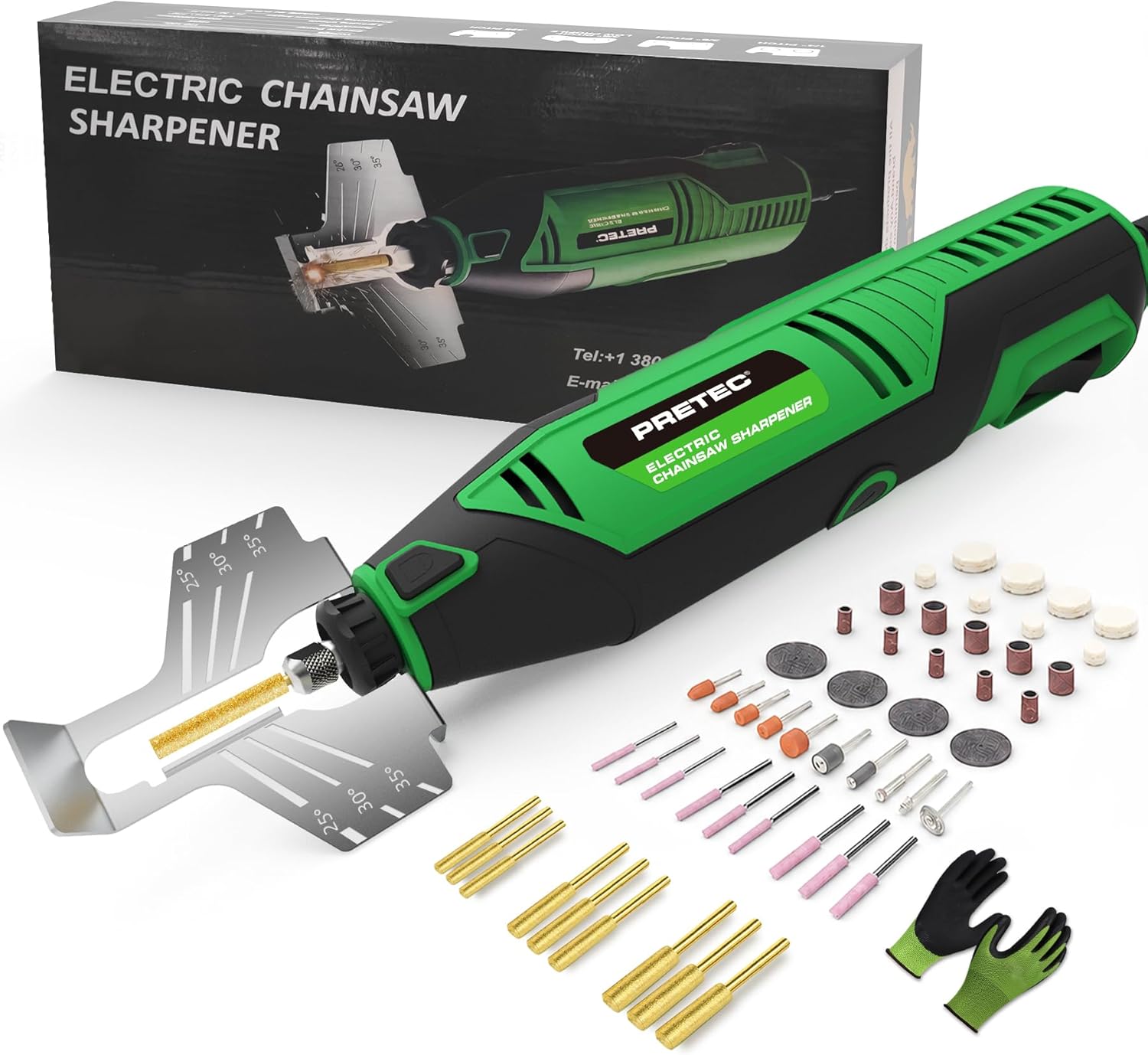
PRETEC Electric Chainsaw Sharpener Kit
|
8.3/10 | $31.49 | Check price |
| Best Overall |
 Oregon 617067 Universal Chainsaw Sharpening Kit |
8.9/10 | $18.88 | Check price |
| Best Value |
 Stihl 5605 Easy File 3/8 Chain Sharpener |
8.9/10 | $43.49 | Check price |
| Best Budget |
 Hipa Universal Chainsaw Sharpening Kit |
8.8/10 | $15.99 | Check price |
| Top Rated |
 Oregon 410-120 Professional Compact Chain Grinder |
8.8/10 | $250.26 | Check price |
| Best Premium |
 Sharp Pebble Cordless Chainsaw Sharpener Kit |
8.9/10 | $64.99 | Check price |
PRETEC Electric Chainsaw Sharpener Kit
This versatile 120V sharpening kit combines a powerful rotary tool with a comprehensive accessory set, including an angle guide and diamond bits. It's designed for users who need a single tool for both precise chain maintenance and general DIY tasks like grinding and polishing. The 6-speed control and durable copper motor aim to deliver professional-grade sharpening from home.
Pros
- Comprehensive 54-piece accessory set for sharpening, grinding, and polishing
- Precision angle attachment (35°/30°/25°) for consistent sharpening results
- High-torque pure copper motor with good heat dissipation for continuous use
- Wide 6-speed range (1000-35,000 RPM) suitable for delicate to heavy-duty work
- Includes 9 titanium-coated diamond bits in multiple sizes for broad chain compatibility
Cons
- Requires a 120V power outlet, limiting true portability
- The large number of accessories may be overwhelming for users seeking a simple, dedicated chain sharpener
Oregon 617067 Universal Chainsaw Sharpening Kit
This portable sharpening kit is a practical solution for maintaining chainsaw and pole saw blades in the field. It bundles essential round and flat files with a guide and handle in a durable, compact pouch, making it a go-to for consistent, manual sharpening on the go.
Pros
- Comprehensive 7-piece kit includes three round file sizes and a flat file for versatility
- Compact canvas travel pouch with tool-specific pockets enhances portability and organization
- Included filing guide aids in achieving accurate depth gauge settings for consistent results
- High user rating of 4.7 stars from nearly 8,000 reviews indicates widespread satisfaction
Cons
- Manual sharpening requires user skill and effort compared to powered alternatives
- The compact toolset is best for field touch-ups, not for major blade rehabilitation
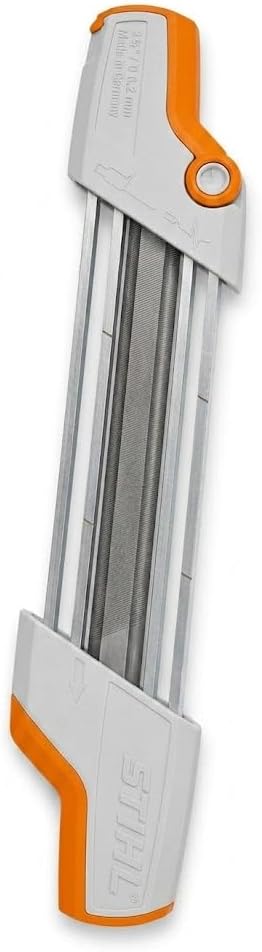
Stihl 5605 Easy File 3/8 Chain Sharpener
Stihl's Easy File combines cutter sharpening and depth-gauge lowering in a single handheld accessory for 3/8-inch chainsaw chains. The 2-in-1 file holder makes it a practical maintenance option for owners who want a simple, brand-matched way to keep full chisel chains cutting cleanly.
Pros
- Resharpens the cutter and lowers the depth gauge in one operation
- Designed for 3/8-inch pitch chains, matching the listed 9.53 millimeter specification
- 2-in-1 file holder simplifies handling and storage
- Strong customer rating of 4.7 from 2,439 reviews
Cons
- Pitch-specific design may not fit other chainsaw chain sizes
- Specified for full chisel chains, so it may not be the right choice for every chain style
Hipa Universal Chainsaw Sharpening Kit
This comprehensive 12-piece kit consolidates nearly every manual sharpening and maintenance tool a chainsaw owner might need. It's designed for users who want to perform routine upkeep themselves, from filing cutters to cleaning bar grooves and checking depth gauges. The included orange pouch enhances portability for field maintenance.
Pros
- All-in-one kit with a wide range of file sizes (5/32" to 13/64") for various chain pitches.
- Includes specialized tools like a depth gauge, flat file, bar groove cleaner, and multi-function quick gauge.
- High-visibility, portable storage pouch for organization and easy transport.
- Wooden handles provide a secure grip for the round and flat files.
- Wide brand and chain pitch compatibility according to the specifications.
Cons
- As a manual filing system, it requires practice and skill to achieve optimal, consistent sharpening results.
- The kit's broad utility means it contains many small components that could be misplaced if not stored carefully.
Oregon 410-120 Professional Compact Chain Grinder
A versatile bench or wall-mounted sharpener designed for semi-professional and home users who regularly cut wood. It handles a wide range of chain pitches with included wheels and offers one-way motor rotation for safety.
Pros
- Versatile sharpening for nearly any chain type up to .404" pitch.
- Includes three grinding wheels and a dressing brick for comprehensive maintenance.
- Can be mounted to a bench or wall for flexible workshop placement.
- One-way motor rotation is noted for enhanced operator safety.
Cons
- Heavier build at 17 pounds may limit portability.
- Corded power source requires proximity to an outlet.
Sharp Pebble Cordless Chainsaw Sharpener Kit
This cordless sharpening kit is designed for convenient on-the-go maintenance of chainsaw chains. It promises ease of use for both beginners and professionals, with an angle guide for consistent sharpening and a compact, portable design.
Pros
- Cordless and portable for use anywhere
- Includes angle guide for consistent sharpening
- Ergonomic design suitable for right or left-handed users
- Comes with multiple sharpening wheel sizes
- Lightweight and compact for easy storage
Cons
- Requires a charged battery (not specified if included)
Best Chainsaw Chain Sharpener Best Ratings Buying Guide
Sharpening Angle Control
The most important thing in a chain sharpener is how well it holds a repeatable angle. A chain that is sharpened too aggressively on one side can pull the saw off line, wear unevenly, and cut less efficiently. The best tools in this category make it easier to keep each cutter consistent so that you remove just enough material to restore bite without shortening chain life unnecessarily.
When comparing sharpeners, pay attention to whether the design gives you fixed angle settings or a more flexible setup. Fixed guides are often easier for newer users, while adjustable systems are better if you maintain different chain types. If you are already comparing tools by maintenance category, our Mower Blade Sharpening page is a useful companion resource because the same precision mindset applies to blade care as well.
The practical test is simple: the sharpener should let you repeat the same motion cutter after cutter. If a tool makes you constantly second-guess alignment, your results will vary no matter how good the abrasive is. That is why angle control matters more than raw speed for most homeowners.
Compatibility With Chain Size and Pitch
Not every chainsaw chain uses the same pitch, gauge, or cutter profile, so compatibility should be high on your checklist. A sharpener that works beautifully on one chain type may be awkward or imprecise on another. Before you buy, confirm that the design supports the chains you actually use rather than the chains you think you might need someday.
For mixed-use households, this becomes even more important. If you own multiple saws, you may need a model that adapts more easily between chain sizes, or one that offers broad adjustment without complicated setup. A good rule is to check whether the sharpener is built for frequent changes in chain configuration or for one primary saw setup.
It also helps to think about workflow. A compatible tool should not force you to remove the chain every time if your goal is occasional touch-up maintenance. The easier it is to match the tool to your chain, the more likely you are to sharpen on schedule instead of waiting until the saw has already become difficult to use.
Ease of Setup and Learning Curve
Some sharpeners are built for speed, while others are built for precision, and that tradeoff affects how easy they are to learn. If you are new to chain maintenance, a simpler setup can be a major advantage because it reduces the chance of over-grinding or setting the wrong angle. Experienced users may prefer more controls, but those controls only help if the layout is intuitive.
Look for designs that clearly separate adjustment steps from sharpening steps. A tool that requires too many repeated measurements can slow you down and make sharpening feel like a chore. In contrast, a model with a straightforward clamping system and visible alignment marks can encourage more frequent maintenance, which is usually the real key to long chain life.
One helpful method is to think in terms of setup time versus repeatability. A slightly longer initial setup is acceptable if every future cutter becomes faster to sharpen. But if the tool is complicated every single time, it may discourage regular use. That is especially true for users who sharpen outdoors between jobs and want dependable results without a long learning curve.
Durability and Build Quality
Since sharpening tools are often used in garages, sheds, and outdoor workspaces, durability matters more than many shoppers realize. A stable frame, secure clamping surfaces, and wear-resistant components all contribute to better long-term value. Even if a sharpener looks simple, its construction should feel solid enough to hold consistent alignment under regular use.
Build quality also affects accuracy. If the tool flexes during use, the cutter angle can drift and the result will be less predictable. That is why we pay attention not only to the design but also to how confident the tool seems when it is under pressure. A sturdy sharpener usually gives you better control and fewer frustrating adjustments.
If you plan to sharpen often, durability becomes even more valuable because you are asking the tool to perform the same task repeatedly with minimal wear. It is better to choose a stronger design once than to replace a cheaper option after a short period of inconsistent results. That principle applies to most cutting-edge maintenance tools, including equipment in our Lawn Sweepers sibling category, where dependable build quality also helps simplify routine yard work.
Speed, Portability, and Field Convenience
Some users sharpen in a workshop, while others prefer a portable solution they can carry to the jobsite or woodshed. Portability matters if you need quick touch-ups between cuts or want to keep a sharpener with your saw gear. A compact tool can be less intimidating and easier to bring along, but it should still offer enough stability to maintain clean results.
Speed is another factor, but it should never come at the cost of consistency. A faster sharpening process is useful only if it still preserves the chain geometry you need. In practical terms, the best approach is to balance convenience with control so you can keep working without sacrificing cut quality.
If you often work in different places, consider how the sharpener stores, mounts, or clamps. A tool that is easy to transport but hard to secure may not be ideal in the field. On the other hand, a heavier unit can be worthwhile if it delivers noticeably steadier sharpening and saves you from rework later.
| Buying Factor | What to Look For | Why It Matters |
|---|---|---|
| Angle control | Repeatable settings and clear guides | Keeps cutter geometry consistent |
| Compatibility | Support for your chain pitch and gauge | Ensures the tool fits your saw |
| Setup ease | Simple clamping and visible markings | Reduces errors and learning time |
| Durability | Rigid frame and secure hardware | Improves long-term accuracy |
| Portability | Compact form or easy mounting | Helps with field use and storage |
Why You Should Trust Us
Our review approach is built around comparison, not hype. We evaluate the information available for each product, look for repeated strengths and weaknesses, and focus on the features that matter most for real-world sharpening tasks. That means we care about angle consistency, usability, compatibility, and construction quality more than promotional claims.
We also try to be transparent about the limits of product data. When manufacturer details are sparse, we avoid filling in the gaps with assumptions. Instead, we rely on the specifications and product positioning that are available so you can make a more informed decision based on the tool’s design and intended use.
Final Thoughts
If you want our best overall recommendation, start with because it sits in the top position of this comparison and represents the strongest all-around choice for most users. In a buying guide like this, the best overall model is the one that balances control, usability, and practical sharpening performance well enough to suit both occasional and regular maintenance.
For a best value style pick, consider . Value matters in this category when a tool can still keep your chain aligned and usable without adding complexity you do not need. If you want to keep exploring related maintenance topics, our Lawn Care Tools category can help you compare other useful equipment for keeping your property in shape.
For a more specialized choice, is a sensible pick for users who prioritize a different style of handling or setup preference. That kind of model can be especially useful if you want a sharper focus on convenience, portability, or a particular sharpening workflow rather than the broadest all-purpose fit. For another category comparison, you can also browse our Lawn Sweepers page.
FAQs
What is the best chainsaw chain sharpener best ratings in 2026?
The best chainsaw chain sharpener best ratings in 2026 depends on whether you value precision, simplicity, or portability most. In general, the strongest option is the one that gives you repeatable sharpening with minimal setup while still fitting your chain type. If you want a starting point, the top-listed model in this guide is the first one to evaluate carefully.
How often should I sharpen my chainsaw chain?
You should sharpen your chain whenever cutting performance starts to drop, chips become smaller, or the saw begins to pull instead of cutting cleanly. Some users sharpen after every significant job, while others wait longer depending on wood type and workload. The key is consistency, because frequent light sharpening is usually better than waiting until the chain is severely dull.
Can beginners use a chainsaw chain sharpener easily?
Yes, but the easiest models are usually the ones with clear guides, simple clamping, and limited adjustment complexity. If you are new to chain maintenance, start with a tool that reduces guesswork rather than one that offers maximum customization. That approach makes it easier to learn proper sharpening habits without damaging the cutters.
What features matter most when choosing the best chainsaw chain sharpener best ratings?
The most important features are angle control, chain compatibility, durability, and ease of use. If you sharpen often, a stable frame and repeatable setup become especially important because they help you get the same result every time. If you want more guidance on matching tools to a broader property-care setup, our Mower Blade Sharpening page offers a useful parallel example of precision maintenance.
Do I need a different sharpener for different chains?
Sometimes, yes. If you use multiple saws with different chain sizes or cutter styles, a more adjustable sharpener can save time and improve fit. If you only use one saw, a simpler purpose-built option may be easier and more consistent than a highly adjustable model.
About the author
Managing Editor & Buying Guides. Based in Asheville, North Carolina. Carolyn manages the editorial calendar and writes our buying guides. A long-time gardener in the Blue Ridge foothills, she knows how much fall leaf cleanup can wear on a yard, so blowers and vacuums are her specialty.