
The 5 Best Aerators For Lawn Care of 2026
A healthy lawn starts with the right aerator, especially when compacted soil is keeping grass from growing evenly. We selected 5 top models in November 2026 from Grenebo, Walensee, Saker and more to help you choose the best fit.
 By Carolyn Brooks
Updated October 27, 2026
If you are trying to improve turf health, reduce soil compaction, and help water and nutrients reach the root zone more effectively, choosing the right aerator matters. This guide to the 5 Best Aerators For Lawn Care is designed to help you compare options for different yard sizes, soil conditions, and lawn care routines. For more lawn equipment ideas, you can also explore our Lawn Care Tools category.

Whether you maintain a cool-season lawn that gets heavy foot traffic or you are trying to revive compacted clay soil, the right aerator can make a noticeable difference over time. In this roundup, we focus on practical buying factors, helpful comparisons, and the type of performance traits that matter most when narrowing down the best aerators for lawn care in November 2026.
| Award | Product | ACMS Score About LAT ScoreACMS Score is calculated based on product ratings, reviews, and sales performance to help you make informed purchasing decisions. | Price | |
|---|---|---|---|---|
| Top Rated |
TreVark T008 Manual Lawn Aerator
|
7.6/10 | $41.99 | Check price |
| Best Overall |
 COCTN Lawn-001 Manual Lawn Aerator |
8.1/10 | $35.79 | Check price |
| Best Premium |
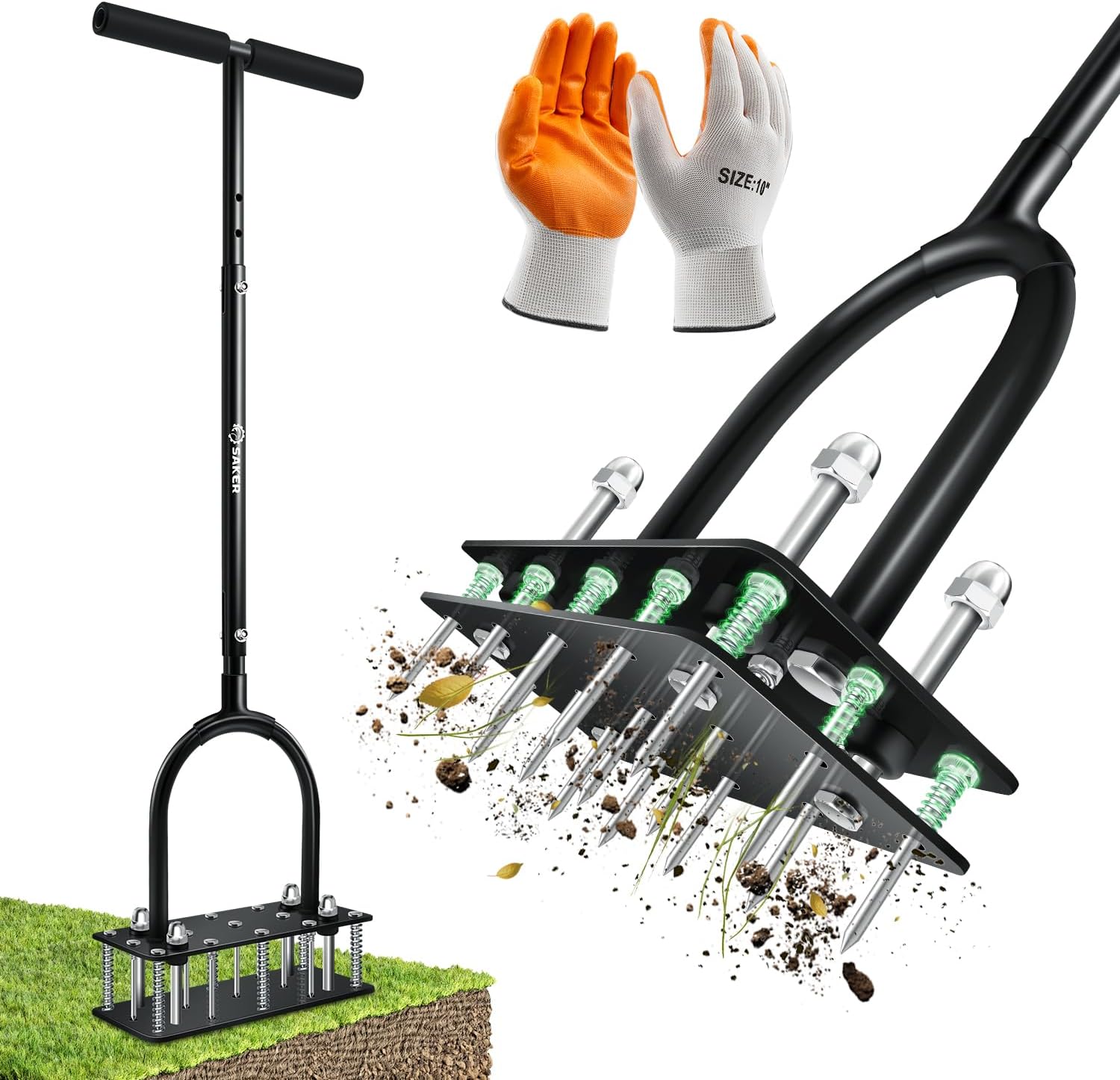 Saker X72945 Lawn Aerator, 15-Spike |
8.0/10 | $49.99 | Check price |
| Best Budget |
 Grenebo AL001 16-Spike Manual Lawn Aerator |
7.5/10 | $30.99 | Check price |
| Best Value |
 Walensee GTL-B952-WA-DE 20-Spike Aerator |
8.1/10 | $39.99 | Check price |
TreVark T008 Manual Lawn Aerator
This manual aerator uses 15 iron spikes to penetrate and loosen soil, aiming to improve lawn drainage and health. Its adjustable T-handle and automatic soil-clearing spring mechanism are designed for user comfort and ease of operation.
Pros
- Adjustable ergonomic T-handle reduces back strain
- Double-layer spring design automatically shakes off soil
- Reinforced heavy-duty construction with rust-resistant coating
Cons
- Requires significant user effort for manual operation
- Mixed customer rating suggests potential quality or performance concerns
COCTN Lawn-001 Manual Lawn Aerator
A manual lawn aerator built around a self-cleaning spring design and three height settings. Its 3-inch steel spikes are aimed at loosening compacted soil while staying lawn-friendly, which makes it a practical fit for routine yard aerating and dethatching.
Pros
- Self-cleaning dual-layer spring design helps shed debris during use.
- Three adjustable height settings improve comfort for different users.
- 3-inch steel spikes are designed to penetrate soil and relieve compaction.
- Mostly preassembled, with quick setup and included wrench.
- Heavy-duty all-steel construction with a detachable design for easier storage.
Cons
- Manual operation requires physical effort.
Saker X72945 Lawn Aerator, 15-Spike
This manual lawn aerator uses 15 sharp iron spikes to punch multiple holes with each step, helping loosen compacted soil and improve drainage and airflow. The adjustable height and double-layer spring design make it a practical option for homeowners who want a simpler way to support healthier grass growth.
Pros
- 15 iron spikes create multiple holes at once for faster aeration.
- Double-layer spring system automatically ejects soil and debris to reduce clogging.
- Adjustable height from 32.2 to 35.4 inches for a better fit.
- Thickened iron construction with rust-resistant coating adds durability.
- Includes protective gloves.
Cons
- Requires suitable soil moisture for best results.
- Manual operation still depends on user effort.
Grenebo AL001 16-Spike Manual Lawn Aerator
This manual aerator offers a straightforward solution for soil compaction, featuring 16 sharp spikes on a stable platform. Its self-cleaning springs and durable, powder-coated construction are designed for long-term use in residential yards. The pre-assembled design with included tools makes it a practical choice for DIY lawn care.
Pros
- Durable construction with rust-resistant powder coating
- Self-cleaning dual-layer springs to reduce clogging
- Comes pre-assembled with necessary tools and gloves for setup
- 3.1-inch spikes designed for deeper soil penetration
- Retractable spikes for safer and more compact storage
Cons
- Manual operation requires physical effort
- 3.8-star rating suggests some user-reported issues with performance or durability
Walensee GTL-B952-WA-DE 20-Spike Aerator
This manual lawn aerator is built for small yards, garden borders, and other tight spots where targeted spot aeration makes more sense than covering a whole lawn. Its 20 steel spikes are designed to open the soil for better air, water, and nutrient flow, which also supports overseeding, reseeding, and lawn repair.
Pros
- Designed for small lawns and tight areas, including edges and garden borders.
- 20 sharp steel spikes help create air channels for root oxygen and better soil penetration.
- Helps water soak in more evenly and can reduce surface runoff and standing water.
- Useful before fertilizing or seeding to improve soil porosity and seed uptake.
- Heavy-duty steel construction with a stable foot plate and manual operation.
Cons
- Best suited to firm but workable soil, not extremely hard, dry ground.
- Not ideal for loose sandy soil.
Best Aerators For Lawn Care Buying Guide
Aeration Type and Lawn Conditions
The first thing to evaluate is how the aerator interacts with your soil. Spike-style tools are easier to use and can be a good fit for light maintenance, while plug or core aeration generally provides a more aggressive loosening effect on compacted ground. If your lawn tends to puddle after rain or feels hard underfoot, a more assertive aeration method is usually the better long-term choice.
You should also match the tool to the condition of the turf itself. For newer lawns, thin turf, or yards with sensitive root systems, a gentler approach can reduce disruption. For established lawns that have gone without attention for a while, more robust aeration often gives you better access to the root zone and a more visible improvement in drainage and nutrient uptake.
A simple rule of thumb is to think about severity. Light compaction calls for a lighter tool; moderate to heavy compaction calls for something that can penetrate deeper and repeat passes efficiently. If you are comparing different styles, it helps to look at the manufacturer’s intended use and the type of soil each product is best suited for, rather than assuming one design works equally well in every yard.
Working Width and Coverage Efficiency
Working width influences how quickly you can cover your lawn. A wider tool can reduce passes across open areas, which matters if you maintain a large yard or want to keep the job manageable during a busy weekend. Narrower tools can still be useful, especially for tight spaces, irregular edges, and smaller lawns where precision matters more than speed.
Coverage efficiency is not only about width. Weight distribution, tine layout, and how smoothly the tool tracks across the surface all affect real-world output. A product that sounds efficient on paper may still feel awkward if it drags, skips, or requires repeated correction while you work. That is why the best aerators for lawn care usually balance width with control and consistency.
If you are deciding between similar products, compare how many passes you would need for your yard. For example, a smaller yard with obstacles may benefit more from maneuverability than maximum width, while a clean rectangular lawn often rewards broader coverage. If you also want to compare other lawn cleanup equipment, our Lawn Sweepers category is a useful companion resource.
Durability of Tines, Frame, and Contact Points
Durability is one of the biggest differences between a tool that lasts a few seasons and one that remains dependable year after year. For aerators, the tine material and frame construction are especially important because those are the parts that face the most resistance from the soil. Stronger contact points help the tool keep its shape and maintain better ground engagement.
You do not need the heaviest tool available, but you do want materials that can stand up to repeated use. Thin components may feel lighter at first, yet they can flex more under pressure and reduce aeration consistency. A sturdier frame can also make the tool feel more stable, which is helpful if you are trying to maintain even pressure across uneven terrain.
When comparing options, look for signs of build quality such as reinforced joins, corrosion-resistant finishes, and a design that keeps high-stress parts from wobbling. These details matter because lawn aeration involves force, friction, and soil exposure. A durable tool not only performs better today, but can also be more economical over time because you are less likely to replace it as quickly.
Ease of Use and Fatigue Management
Even the most effective aerator can become frustrating if it is tiring to use. Handle shape, overall balance, and how much pressure the tool requires all influence how long you can work before fatigue sets in. If you plan to aerate a large lawn or perform multiple passes in one session, comfort matters as much as raw performance.
Think about how the tool fits your body and your workflow. If it requires awkward posture or repeated exertion in a confined stance, you may find yourself rushing or skipping sections. A better-designed aerator should help you keep a steady rhythm while minimizing strain on your hands, back, and shoulders.
For many homeowners, the best choice is the one they can actually use consistently. If a tool makes aeration feel like a major chore, it is less likely to become part of your regular lawn care routine. That is why ease of use should always be considered alongside effectiveness, especially if you are maintaining your own yard without extra help.
Compatibility With Your Lawn Care Schedule
Timing and routine matter just as much as the tool itself. Aeration is typically most helpful when paired with watering, overseeding, or fertilizing plans, because the openings created in the soil can support better establishment and nutrient movement. If you already have a seasonal maintenance plan, choose an aerator that fits into that schedule without becoming too cumbersome to use.
It also helps to think about how often you expect to use the tool. A homeowner who aerates once or twice a year can prioritize straightforward setup and reliable performance. Someone who manages multiple properties or takes a more active lawn care approach may want something that is easier to store, faster to deploy, and sturdy enough for repeated use.
To make the comparison easier, here is a quick decision framework:
| Need | What to prioritize | Why it matters |
|---|---|---|
| Small yard | Maneuverability | Helps you work around tight spaces and landscaping |
| Large open lawn | Wider coverage | Reduces total passes and saves time |
| Compacted soil | Stronger penetration | Improves root access and drainage |
| Frequent use | Durable construction | Supports repeat performance over time |
Why You Should Trust Us
We build our recommendations by comparing product listings, feature sets, available product data, and category-level use cases rather than relying on vague marketing language. That approach helps us focus on the details that matter most to shoppers, including build quality, usability, and how well a product fits a specific type of lawn care task.
Our goal is to provide a practical, transparent overview that helps you narrow down the best aerators for lawn care without guesswork. We do not claim hands-on testing unless product evidence supports it, so our commentary stays grounded in the information available and in how these tools are typically used in real lawn maintenance routines.
Final Thoughts
If you want a strong starting point, our best overall recommendation is the Product 1. It sits at the top of the roundup and is the most sensible first choice for readers who want a balanced option that can serve as a dependable all-around aerator for routine yard care.
For shoppers focused on value and flexibility, the Product 2 is worth close attention. It is a practical pick if you want a no-fuss solution that still belongs in a top-tier comparison, especially when you are prioritizing straightforward lawn upkeep over specialized features. For a more category-wide perspective, you can also browse our Lawn Aerators category page.
If you need a specific-use recommendation, the Product 6 stands out as a focused option for readers with a defined lawn care routine or a particular yard layout in mind. For readers comparing related lawn cleanup tools, our Lawn Sweepers category may help you build a more complete maintenance plan.
FAQs
What is the best aerators for lawn care for an average yard?
For an average residential yard, the best choice is usually a tool that balances coverage, control, and durability. You want something that is easy enough to use regularly but still capable of making a meaningful difference in compacted areas. The right option is often the one that fits your yard size and the condition of your soil rather than the one with the most aggressive design.
How often should you use Best Aerators For Lawn Care in 2026?
Most lawns do not need constant aeration, so frequency depends on soil compaction, traffic, and grass type. Many homeowners use aeration as part of a seasonal maintenance cycle rather than a weekly task. If your lawn sees heavy foot traffic or has drainage issues, you may benefit from using it more consistently as part of your broader lawn care plan.
Do best aerators for lawn care work better before seeding?
Yes, aeration can be especially helpful before overseeding because it opens the soil and can improve seed-to-soil contact. That combination often supports better germination and stronger establishment in patchy areas. If overseeding is part of your plan, aeration is usually best timed just before that step.
Can I use Best Aerators For Lawn Care on clay soil?
Clay soil often benefits from aeration because it tends to compact more easily and can restrict airflow and drainage. A more effective aeration design is usually preferable for this kind of soil, since lighter tools may not create enough soil disruption. If your yard has persistent puddling or hard-packed areas, choosing the right tool becomes especially important.
Where can I compare more lawn care tools?
If you want to expand beyond aerators, our Lawn Care Tools and Lawn Sweepers pages are good places to continue. They make it easier to compare equipment by category and build a more complete lawn maintenance setup.
About the author
Managing Editor & Buying Guides. Based in Asheville, North Carolina. Carolyn manages the editorial calendar and writes our buying guides. A long-time gardener in the Blue Ridge foothills, she knows how much fall leaf cleanup can wear on a yard, so blowers and vacuums are her specialty.