
The 9 Best Gas Powered Lawn Aerator of 2026
A gas powered lawn aerator can help break up compacted soil and improve air, water, and nutrient flow to your grass. This roundup covers 9 of the best gas powered lawn aerator options in November 2026 so you can choose the right one with confidence.
 By Maria Delgado
Updated October 27, 2026
If you are trying to find the best gas powered lawn aerator, you are probably looking for a tool that can break through compacted soil faster and with less effort than a manual alternative. Gas-powered options are designed for bigger yards, tougher ground, and homeowners who want a more aggressive aeration pass without being tied to a cord or battery runtime.

In this guide, we compare 9 options across performance, usability, and long-term value so you can narrow the field quickly. If you are also researching other lawn cleanup tools, our Lawn Care Tools category is a helpful place to start.
| Award | Product | ACMS Score About LAT ScoreACMS Score is calculated based on product ratings, reviews, and sales performance to help you make informed purchasing decisions. | Price | |
|---|---|---|---|---|
| Best Premium |
LawnVigor LV-ALT4 3-Tine Lawn Aerator
|
8.6/10 | $41.99 | Check price |
| Top Rated |
 FurFrolic STQ Manual Lawn Aerator with 15 Spikes |
8.0/10 | $29.99 | Check price |
| Also Great |
 TreVark T008 Manual Lawn Aerator |
7.6/10 | $41.99 | Check price |
| Also Great |
 Sturdon STQ-304-3 42-Inch Stainless Aerator |
7.5/10 | $37.99 | Check price |
| Best Budget |
 COCTN Lawn-001 Manual Lawn Aerator |
8.1/10 | $35.79 | Check price |
| Best Overall |
 Zalawn Manual Core Aerator with 3 Replaceable |
8.9/10 | $39.99 | Check price |
| Also Great |
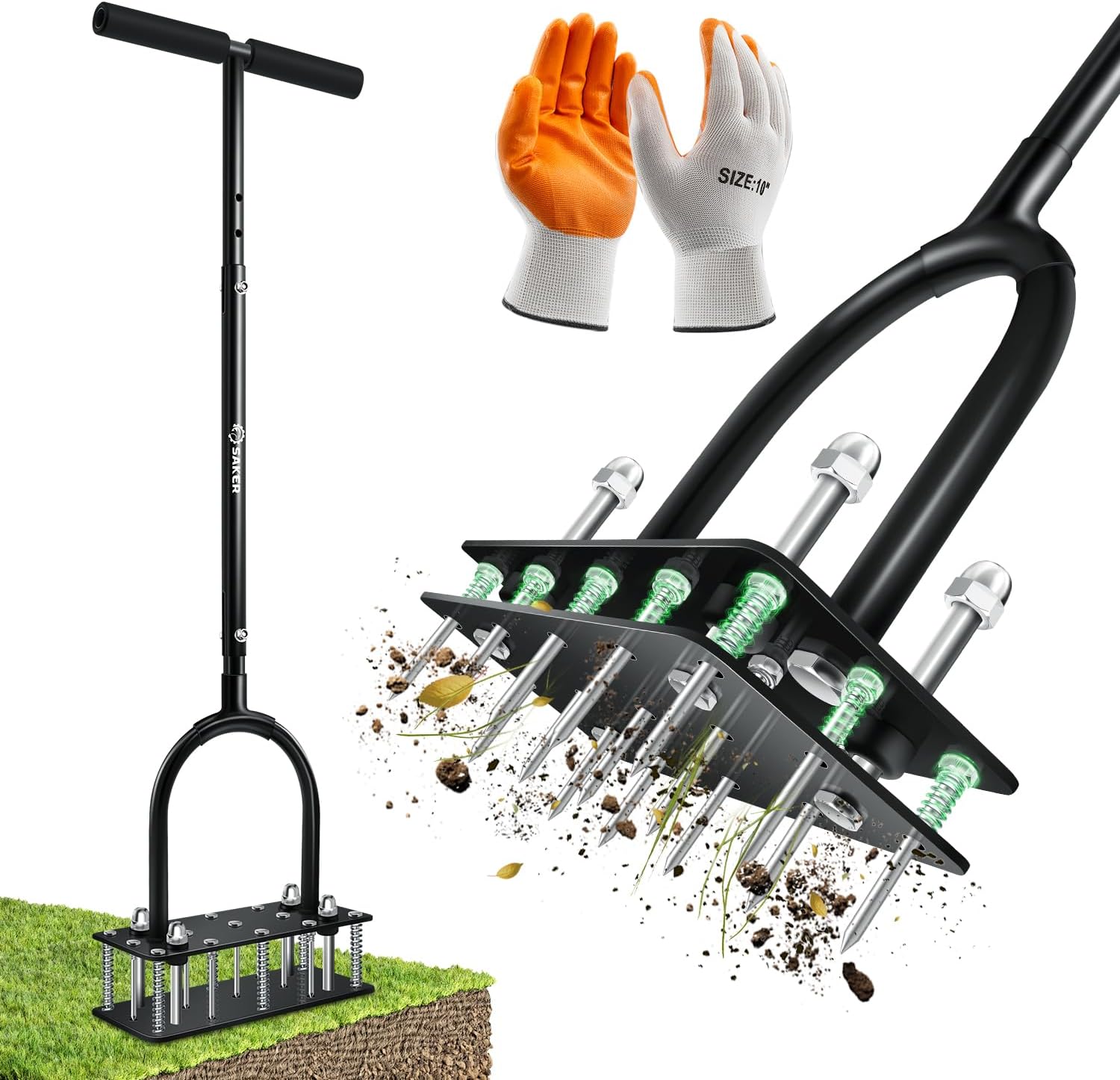 Saker X72945 Lawn Aerator, 15-Spike |
8.0/10 | $49.99 | Check price |
| Most Popular |
 Grenebo AL001 16-Spike Manual Lawn Aerator |
7.5/10 | $30.99 | Check price |
| Best Value |
 Walensee GTL-B952-WA-DE 20-Spike Aerator |
8.1/10 | $39.99 | Check price |
LawnVigor LV-ALT4 3-Tine Lawn Aerator
A manual core aerator built for compacted soil, with three hollow tines that remove plugs and help air, water, and nutrients reach the root zone. The ergonomic handle and replaceable tines make it a practical pick for homeowners who want a straightforward tool for routine lawn care.
Pros
- Three hollow tines are designed to remove soil plugs and reduce clogging.
- Sturdy metal construction with heat-treated tines for durability.
- Ergonomic, non-slip handle helps improve comfort and control.
- Replaceable hollow tines support easier maintenance over time.
Cons
- Needs moist soil for best use, according to the product instructions.
- Requires careful handling, since rocking, twisting, or prying can be an issue when the tool is in the ground.
FurFrolic STQ Manual Lawn Aerator with 15 Spikes
This heavy-duty manual aerator is designed for homeowners tackling compacted soil. Its dual-layer spring system helps prevent clogging, while the 15 reinforced metal tines are built to handle tough terrain.
Pros
- Automatic debris-shedding spring system reduces clogs
- 15 solid, 3-inch metal tines for deep soil penetration
- Heavy-duty all-steel construction resists bending
- Ergonomic T-handle with cushioned grip for comfortable use
- Comes pre-assembled and is ready for quick setup
Cons
- Manual operation requires physical effort
- Limited to a single color option
TreVark T008 Manual Lawn Aerator
This manual aerator uses 15 iron spikes to penetrate and loosen soil, aiming to improve lawn drainage and health. Its adjustable T-handle and automatic soil-clearing spring mechanism are designed for user comfort and ease of operation.
Pros
- Adjustable ergonomic T-handle reduces back strain
- Double-layer spring design automatically shakes off soil
- Reinforced heavy-duty construction with rust-resistant coating
Cons
- Requires significant user effort for manual operation
- Mixed customer rating suggests potential quality or performance concerns
Sturdon STQ-304-3 42-Inch Stainless Aerator
Sturdon's upgraded manual aerator uses a full 42-inch stainless steel frame and three detachable hollow tines to pull soil plugs rather than only punching holes. The anti-slip foot pad and removable center tine help with steady pressure on compacted or slightly moist yard soil. It is a good fit for homeowners who want a rust-resistant hand tool, though it still demands physical effort.
Pros
- 100% 304 stainless steel construction with no coated parts
- Three detachable hollow tines pull soil plugs and can be cleaned individually
- 42-inch handle supports more upright use than shorter 37-inch aerators
- Anti-slip silicone foot pad helps keep footing steady on wet soil
- Removing the center tine reduces resistance in hard soil
Cons
- It requires steady downward pressure and slightly moist soil for best penetration
- No spare or replacement tines are included
- Dry or very hard ground may need pre-watering and extra preparation
COCTN Lawn-001 Manual Lawn Aerator
A manual lawn aerator built around a self-cleaning spring design and three height settings. Its 3-inch steel spikes are aimed at loosening compacted soil while staying lawn-friendly, which makes it a practical fit for routine yard aerating and dethatching.
Pros
- Self-cleaning dual-layer spring design helps shed debris during use.
- Three adjustable height settings improve comfort for different users.
- 3-inch steel spikes are designed to penetrate soil and relieve compaction.
- Mostly preassembled, with quick setup and included wrench.
- Heavy-duty all-steel construction with a detachable design for easier storage.
Cons
- Manual operation requires physical effort.
Zalawn Manual Core Aerator with 3 Replaceable
A robust manual aerator designed to tackle compacted and clay-heavy soils by extracting 4-inch-deep cores, not just poking holes. Its non-clogging mechanism and heat-treated steel construction are built for continuous use, making it a durable choice for homeowners dealing with tough ground conditions.
Pros
- Extracts soil cores up to 4 inches deep for effective aeration
- Heat-treated steel tines resist bending and snapping
- Non-clogging design allows for continuous work
- Replaceable tines extend the tool's lifespan
- Ergonomic grip and balanced weight reduce user fatigue
Cons
- Manual operation requires significant physical effort for large areas
- Effectiveness is highly dependent on suitable soil conditions
Saker X72945 Lawn Aerator, 15-Spike
This manual lawn aerator uses 15 sharp iron spikes to punch multiple holes with each step, helping loosen compacted soil and improve drainage and airflow. The adjustable height and double-layer spring design make it a practical option for homeowners who want a simpler way to support healthier grass growth.
Pros
- 15 iron spikes create multiple holes at once for faster aeration.
- Double-layer spring system automatically ejects soil and debris to reduce clogging.
- Adjustable height from 32.2 to 35.4 inches for a better fit.
- Thickened iron construction with rust-resistant coating adds durability.
- Includes protective gloves.
Cons
- Requires suitable soil moisture for best results.
- Manual operation still depends on user effort.
Grenebo AL001 16-Spike Manual Lawn Aerator
This manual aerator offers a straightforward solution for soil compaction, featuring 16 sharp spikes on a stable platform. Its self-cleaning springs and durable, powder-coated construction are designed for long-term use in residential yards. The pre-assembled design with included tools makes it a practical choice for DIY lawn care.
Pros
- Durable construction with rust-resistant powder coating
- Self-cleaning dual-layer springs to reduce clogging
- Comes pre-assembled with necessary tools and gloves for setup
- 3.1-inch spikes designed for deeper soil penetration
- Retractable spikes for safer and more compact storage
Cons
- Manual operation requires physical effort
- 3.8-star rating suggests some user-reported issues with performance or durability
Walensee GTL-B952-WA-DE 20-Spike Aerator
This manual lawn aerator is built for small yards, garden borders, and other tight spots where targeted spot aeration makes more sense than covering a whole lawn. Its 20 steel spikes are designed to open the soil for better air, water, and nutrient flow, which also supports overseeding, reseeding, and lawn repair.
Pros
- Designed for small lawns and tight areas, including edges and garden borders.
- 20 sharp steel spikes help create air channels for root oxygen and better soil penetration.
- Helps water soak in more evenly and can reduce surface runoff and standing water.
- Useful before fertilizing or seeding to improve soil porosity and seed uptake.
- Heavy-duty steel construction with a stable foot plate and manual operation.
Cons
- Best suited to firm but workable soil, not extremely hard, dry ground.
- Not ideal for loose sandy soil.
Buying Guide for the best gas powered lawn aerator
The right gas powered aerator should do more than simply punch holes in the turf. It should match your lawn size, soil condition, storage space, and how often you plan to aerate. A model that is easy to maneuver on a flat suburban lawn may feel underpowered on thick clay soil, while a heavier-duty unit can be more than you need for a small yard.
Aeration Depth and Tine Design
Aeration depth is one of the most important factors because it determines how well the machine relieves compaction and improves root access to air, water, and nutrients. Deeper penetration usually helps more in dense soil, but it can also demand more from the engine and the operator. If your lawn has heavy clay or has not been aerated in a long time, you want a machine that can maintain consistent depth instead of skipping over hard spots.
Tine design matters just as much as depth. Hollow tines remove small plugs of soil and are generally preferred for true core aeration, while solid tines make smaller punctures and may be better for lighter upkeep. Before buying, think about whether your lawn needs aggressive recovery support or routine seasonal maintenance. If you want a broader comparison of turf tools, our Lawn Aerators category page is a useful reference.
| What to compare | Why it matters | Best fit |
|---|---|---|
| Deeper core removal | Helps reduce compaction in stubborn soil | Thick clay or high-traffic lawns |
| Shallower puncture pattern | Easier to push through and maneuver | Light maintenance use |
| Even tine spacing | Improves coverage and reduces missed strips | Medium to large lawns |
Engine Power and Torque
Gas powered lawn aerators rely on engine output to drive tines through compact ground. More power can mean smoother operation in tough soil, fewer stalls, and better consistency across the yard. That said, raw power is only useful when the machine is balanced well enough for the operator to control it comfortably.
When comparing models, look at how the machine is built to translate engine power into actual turf contact. A lightweight frame with a strong engine can still struggle if traction is poor, while a heavier chassis may feel stable but harder to turn. The best choice is usually the one that keeps moving without forcing you to make repeated passes over the same area.
The design of the Product 3 unit is a good example of why power delivery should be evaluated alongside handling. A more capable machine is only useful if you can guide it cleanly across the lawn, especially along edges, near landscaping beds, and around slopes.
Coverage Width and Yard Size
Coverage width determines how much ground you can treat in each pass, which directly affects the time required to aerate the yard. A wider machine can save time on larger properties, but it may be harder to manage in tighter spaces or around obstacles. Smaller decks are often more practical for yards with lots of trees, garden features, or narrow side paths.
Think of coverage as a tradeoff between speed and precision. If your lawn is open and mostly rectangular, wider coverage usually makes sense. If your yard is split into sections, or if you need to maneuver through gates and around curves, a slightly narrower machine can be less frustrating. For homeowners comparing broader yard tools, the Lawn Sweepers category can also be useful for seasonal cleanup planning.
Weight, Traction, and Control
Gas powered aerators often need enough weight to keep the tines engaged with the soil, but too much weight can make the machine difficult to turn or transport. The best balance depends on your strength, the slope of your lawn, and how often you need to lift or store the machine. A model that feels stable on the ground but manageable when turning will usually be less tiring over the course of a full lawn.
Traction is especially important on damp soil or slightly sloped areas. If the wheels slip, the aerator may leave uneven rows or require extra passes. Look for a build that keeps the machine planted without becoming cumbersome. Control features such as ergonomic handles and straightforward speed management can make a noticeable difference on longer jobs.
The Product 5 unit is worth paying attention to if you care about balance and maneuverability. In this category, a machine that is easier to steer can save as much effort as a more powerful engine, particularly when you are working around flower beds or driveway edges.
Maintenance, Durability, and Long-Term Ownership
Because gas powered tools have more moving parts than manual equipment, long-term ownership should be part of your decision. You will want to think about routine engine care, tine wear, storage space, and how easy it will be to keep the machine ready between seasons. A durable frame and accessible service points can help reduce frustration later on.
Durability also includes how the aerator will handle repeated contact with soil, rocks, and uneven patches. A machine that holds up well season after season is often the better value, even if it costs more up front in some situations. If your property needs a tool that can stay in the rotation for years, this is where build quality should weigh heavily in your decision.
Ease of Use and Storage
Even a strong aerator should be easy enough to use that you will actually pull it out when the lawn needs attention. Consider whether the handle folds, whether the machine can be stored in a garage without taking over the space, and whether starting and steering seem straightforward. Convenience is especially important if you only aerate a few times each season.
Ease of use also affects how well you can cover the lawn evenly. If the machine feels awkward, you are more likely to miss areas or overwork others. That is why it helps to choose a design that matches your comfort level, not just the largest or most aggressive option available.
Why You Should Trust Us
We approach product reviews by comparing available product data, feature sets, and category-specific performance expectations rather than relying on hype or vague claims. For gas powered lawn aerators, that means we focus on the details that matter most in real use, including soil penetration, control, durability, and practical ownership concerns.
Our goal is to help you make a decision based on clear criteria. We do not assume every lawn has the same needs, so we evaluate which products are better suited for larger yards, harder soil, or easier handling. That kind of comparison is more useful than simply naming a winner without context.
Final Thoughts on the best gas powered lawn aerator
For the best overall choice, we recommend Product 1 because it sits at the top of the comparison list and represents the strongest starting point for most buyers who want a dependable gas powered aerator. If you want a model that balances performance and practicality, Product 1 is the first one we would narrow in on.
For shoppers looking for a more value-focused option, Product 2 is worth a close look because it gives you another comparison point near the top of the lineup without forcing you to compromise your research process. If your yard is more demanding or you want to prioritize maneuverability, Product 3 is a smart pick to evaluate for more specific lawn conditions. You can also explore more yard-care comparisons in our Lawn Care Tools category and the Lawn Aerators page.
Ultimately, the best gas powered lawn aerator is the one that fits your soil, yard layout, and comfort level. If you choose based on aeration depth, control, and long-term durability rather than looks alone, you will end up with a tool that makes seasonal lawn care much easier.
FAQs
What is the best gas powered lawn aerator in 2026?
The best gas powered lawn aerator is the one that matches your lawn size and soil condition, but the top-ranked model in our comparison is the strongest starting point for most buyers. If you are unsure where to begin, focus first on power, traction, and how easy the machine is to guide across your yard.
How often should I use a best gas powered lawn aerator?
Most lawns do not need frequent aeration, so using a gas powered aerator too often can be unnecessary. A seasonal schedule is usually enough for many yards, but compacted soil, heavy foot traffic, or clay-heavy ground may require more attention depending on conditions.
Is a gas powered lawn aerator better than a manual one?
Yes, for larger lawns or tougher soil, a gas powered model is usually much easier to use and more effective. Manual aerators can work for small spaces or light maintenance, but they require more physical effort and often take longer to cover the same area.
What should I look for in the best gas powered lawn aerator for heavy soil?
For heavy soil, look for strong penetration, stable traction, and a design that can keep moving through compacted ground. You should also pay attention to weight distribution, because a machine that is too light may struggle to stay engaged with the soil.
Can I store a gas powered lawn aerator in a small garage?
Often yes, but storage depends on the overall footprint and whether the handle folds down. If garage space is tight, choose a model that is easier to park and maintain between uses. For more yard maintenance guidance, our Lawn Sweepers category can also help you plan a complete cleanup routine.
About the author
Editor, Garden Hand Tools. Based in Phoenix, Arizona. Maria grows vegetables and native desert plants in a small backyard and cares most about tools that stay sharp and comfortable in the heat. She writes about pruners, loppers, shovels, and everyday hand tools.